BP305P – Organic Chemistry-II Lab Manual Practical No 3
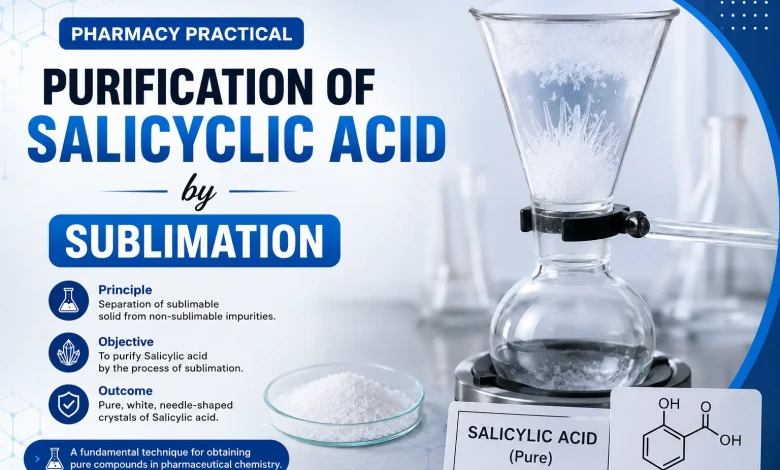
Purification of Salicyclic acid by submilation
Paid Advertisements
Table of Contents
Presentation of this practical
Podcast of this practical
In Hindi
In Marathi
Practical No 3
About the practical
This laboratory manual provides a detailed protocol for purifying salicylic acid using the sublimation method. The document explains that certain solids can bypass the liquid phase, turning directly into vapor before recrystallizing on a cooled surface. Students are guided through a step-by-step procedure involving controlled heating in a china dish covered by an inverted funnel. The text emphasizes the importance of monitoring temperatures to prevent chemical decomposition and ensuring the purity of the resulting white, needle-shaped crystals. Finally, the source outlines how to evaluate the success of the experiment by calculating the percentage yield and measuring the melting point of the refined product.
Line page content
Aim
To purify impure salicylic acid by sublimation and determine the percentage yield.
Learning Objectives
Upon completion of this experiment, I will be able to:
- Explain the principle of sublimation.
- Identify compounds that can be purified by sublimation.
- Perform the sublimation process using the correct laboratory apparatus.
- Collect purified salicylic acid crystals.
- Calculate the percentage yield of the purified salicylic acid.
- Check the purity of salicylic acid by observing the crystals and measuring the melting point.
Learning Outcomes
After successful completion of this practical, I will be able to:
- Explain the principle and uses of sublimation.
- Identify organic compounds that can be purified by sublimation.
- Set up and safely use a sublimation apparatus.
- Purify salicylic acid by the sublimation method.
- Calculate the percentage yield of the purified product.
- Evaluate the purity of the product using crystal appearance and melting point.
Reference
Vogel’s Textbook of Practical Organic Chemistry, Longman Scientific & Technical, 1989.
Requirements
Apparatus
China dish or porcelain evaporating dish, glass funnel, Cotton plug, Tripod stand, Wire gauze, Bunsen burner or hot plate, Spatula, Watch glass, Forceps, Filter paper, Ice cubes or wet filter paper (optional for cooling).
Chemicals
Impure salicylic acid
Instruments
Analytical balance, Hot Plate/Heating mantle
Principle
Sublimation is a physical purification technique in which certain solid substances convert directly into vapour upon heating without passing through the liquid state. The vapours condense on a cold surface to produce purified crystals. Non-volatile impurities remain behind in the sublimation vessel, thereby effecting purification.
Salicylic acid is an aromatic hydroxy acid that sublimes upon gentle heating (below its decomposition temperature). This property enables its purification from non-volatile impurities by sublimation. The success of the process depends on careful control of temperature to avoid decomposition while allowing sufficient sublimation.
Theory
Sublimation is commonly employed for the purification of volatile organic solids such as salicylic acid, camphor, benzoic acid, naphthalene, iodine, anthracene, and phthalic anhydride.
The process consists of two stages:
- Sublimation: The impure solid absorbs heat and changes directly into vapour.
- Deposition: The vapours come in contact with a cooled surface and condense as pure crystals.
The impurities, being non-volatile, remain in the original vessel.
Salicylic acid (2-hydroxybenzoic acid; C₇H₆O₃) is a white crystalline aromatic carboxylic acid possessing both hydroxyl and carboxyl functional groups. It exhibits sublimation on careful heating and has a melting point of approximately 158–159°C. Purified salicylic acid appears as fine white needle-shaped crystals.
Procedure
Step 1: Weighing
Accurately weigh 1 g of impure salicylic acid.
Step 2: Preparation of Apparatus
- Transfer the impure salicylic acid into a clean, dry china dish.
- Cover the dish with a clean inverted glass funnel.
Plug the stem of the funnel loosely with cotton to prevent escape of vapours while allowing pressure equalization.
Step 3: Sublimation
- Place the apparatus on a wire gauze over a tripod stand.
- Heat the china dish gently using a low flame or hot plate.
- Avoid excessive heating, as salicylic acid may decompose.
- Vapours of salicylic acid rise and condense on the inner surface of the funnel as white crystals.
Step 4: Cooling
- Stop heating after sufficient sublimation.
- Allow the apparatus to cool completely before dismantling.
Step 5: Collection of Crystals
- Carefully remove the funnel.
- Scrape the deposited crystals gently from the inner wall of the funnel using a clean spatula.
- Transfer the purified crystals onto a watch glass.
Step 6: Weighing
Dry the purified crystals, if necessary, and record their weight.
Precautions
- Use clean and completely dry apparatus.
- Heat gently to avoid decomposition of salicylic acid.
- Ensure proper fitting of the inverted funnel to minimize vapour loss.
- Keep the funnel cool for efficient condensation.
- Do not remove the funnel while the apparatus is hot.
- Scrape crystals carefully to avoid contamination.
- Avoid direct high flame.
- Wear safety goggles and handle hot glassware with forceps.
Sources of Error
- Overheating causing decomposition.
- Escape of vapours due to improper sealing.
- Incomplete sublimation.
- Loss of crystals during scraping.
- Contamination from dirty apparatus.
- Incomplete cooling before collection.
Result
The Impure salicylic acid was successfully purified by the sublimation method with % yield of ______ and melting point of ______ °C.
Blank page content
Aim
To purify impure salicylic acid by sublimation and determine the percentage yield.
Observations
- Weight of watch glass + crude salicylic acid: _________ g
- Weight of watch glass after transfer: _________ g
- Weight of crude salicylic acid taken (1-2): _________ g
- Weight of watch glass + recrystallized salicylic acid: _________ g
- Weight of watch glass after transfer: _________ g
- Weight of recrystallized salicylic acid taken (4-5): _________ g
- Melting point of recrystallized salicylic acid: _________ °C
Calculations
Result
The Impure salicylic acid was successfully purified by the sublimation method with % yield of ______ and melting point of ______ °C.
Synopsis Questions
- Define sublimation. Explain its principle.
- Why is sublimation used for the purification of salicylic acid?
- Name any four organic compounds that can be purified by sublimation.
- What are the two stages involved in the sublimation process?
- Why is salicylic acid suitable for purification by sublimation?
- Draw and label the experimental setup used for sublimation.
- State the role of the inverted glass funnel in the sublimation apparatus.
- Why is the stem of the glass funnel loosely plugged with cotton?
- Why should salicylic acid be heated gently during sublimation?
- Why should the apparatus be allowed to cool before removing the funnel?
- Mention any four precautions to be followed during sublimation.
- List any four sources of error in the sublimation process.
- How can the purity of purified salicylic acid be evaluated?
- What is the melting point range of pure salicylic acid?
- Write the formula used to calculate the percentage yield of purified salicylic acid.
- Differentiate between sublimation and recrystallization. (Any two points)
- What characteristics indicate that salicylic acid has been successfully purified?
- What are the advantages of sublimation as a purification method?
- Why do non-volatile impurities remain behind during sublimation?
- What is the purpose of using a clean and dry apparatus in sublimation?
Viva Voce Questions
- What is sublimation?
- State the principle of sublimation.
- Why is salicylic acid purified by sublimation?
- Name five compounds that can be purified by sublimation.
- Why is an inverted funnel used?
- Why is the funnel stem plugged with cotton?
- Why should heating be gentle?
- What type of impurities are removed by sublimation?
- What precautions should be taken during sublimation?
- What is the melting point of pure salicylic acid?
- What is the appearance of purified salicylic acid?
- What happens if excessive heating is applied?
- Why should the apparatus be cooled before opening?
- How can purity of the product be assessed?
- What are the advantages and limitations of sublimation?