

BP305P – Organic Chemistry-II Lab Manual Practical No 2
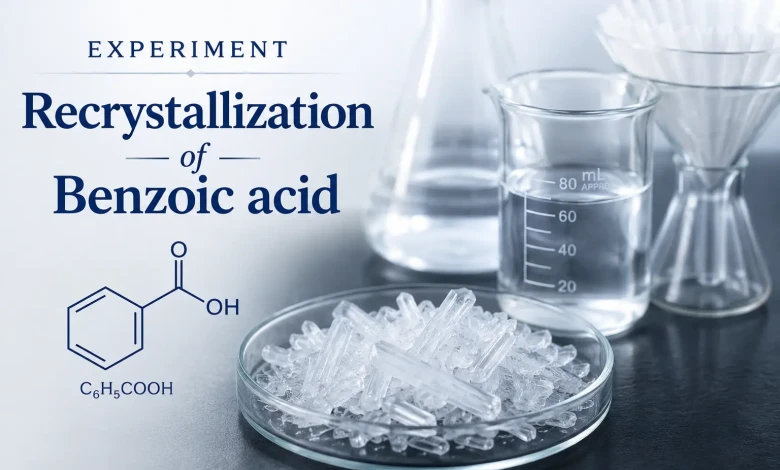
Recrystallization of Benzoic acid
Our Other Brands
Youtube channel

Telegram channel

Paid Advertisements

Table of Contents
Presentation of this practical
Podcast of this practical
In Hindi
In Marathi
Practical No 2
About The practical
This laboratory manual provides a comprehensive guide for purifying benzoic acid through the recrystallization process. It details the scientific principle that substances become more soluble as solvent temperatures increase, specifically highlighting why distilled water is an effective medium for this procedure. Students are instructed on every practical phase, from initial dissolution and hot filtration to the final stages of crystallization and drying. The document also outlines methods for evaluating purity by measuring the product’s melting point and calculating the percentage yield. Ultimately, the text serves as a structured educational framework for mastering fundamental organic chemistry techniques.
Line page content
Aim
To purify impure benzoic acid by recrystallization using distilled water and determine the percentage yield.
Learning Objectives
Upon completing this experiment, I will be able to:
- Explain the basic principle of recrystallization and its role in purifying organic compounds.
- Choose a suitable solvent for recrystallization based on the solubility of the compound.
- Carry out all the steps involved in recrystallization, including dissolving the sample, hot filtration, crystallization, filtration, washing, and drying the crystals.
- Calculate the percentage yield of the purified benzoic acid.
- Determine the purity of the recrystallized benzoic acid by observing its crystal appearance and measuring its melting point.
Learning Outcomes
After successfully completing this practical, I will be able to:
- Use the recrystallization technique to purify an organic compound.
- Select an appropriate solvent for effective recrystallization based on solubility principles.
- Perform the complete recrystallization process using standard laboratory procedures.
- Calculate the percentage yield of the purified product accurately.
- Evaluate the purity of recrystallized benzoic acid by examining its crystal quality and determining its melting point.
Reference
Vogel’s Textbook of Practical Organic Chemistry, Longman Scientific & Technical, 1989.
Requirements
Apparatus
250 mL beaker, 250 mL conical flask, Measuring cylinder, Glass rod, Funnel, Fluted filter paper, Filter paper and Buchner funnel with suction flask (if available), water bath, Ice bath, Watch glass, Spatula
Chemicals
Impure benzoic acid, distilled water, activated charcoal (optional)
Instruments
Hot plate, Analytical weighing balance, Drying oven or desiccator
Principle
Recrystallization is the most widely used laboratory technique for the purification of solid organic compounds. It is based on the principle that the solubility of a substance varies with temperature. An impure solid is dissolved in the minimum amount of a suitable hot solvent to form a saturated solution. As the solution cools, the solubility of the compound decreases and pure crystals separate from the solution, while most soluble impurities remain in the mother liquor. Insoluble impurities are removed by hot filtration before crystallization.
Water is an ideal solvent for recrystallizing benzoic acid because benzoic acid is sparingly soluble in cold water but readily soluble in boiling water. This large difference in solubility allows efficient recovery of pure crystals upon cooling.
Theory
A suitable solvent for recrystallization should possess the following properties:
- Dissolve the compound readily at its boiling point.
- Dissolve only a small amount of the compound at room temperature.
- Not react chemically with the compound.
- Dissolve impurities either completely or not at all.
- Be sufficiently volatile for easy removal after crystallization.
Benzoic acid (C₆H₅COOH) is an aromatic carboxylic acid that forms colourless needle-shaped crystals. It exhibits a significant increase in solubility with increasing temperature, making water a suitable recrystallization solvent.
Approximate Solubility of Benzoic Acid in Water
Temperature | Solubility |
25°C | 0.34 g/100 mL |
50°C | 0.95 g/100 mL |
75°C | 2.2 g/100 mL |
100°C | 6.8 g/100 mL |
This marked change in solubility is responsible for the separation of pure crystals during cooling.
Procedure
Step 1: Weighing
Accurately weigh 1 g of impure benzoic acid and transfer it to a clean 250 mL beaker.
Step 2: Dissolution
- Add approximately 75 mL of distilled water.
- Heat the mixture gently while stirring continuously.
- Add small portions of hot distilled water only if necessary until the benzoic acid dissolves completely.
- Avoid adding excess solvent.
Step 3: Decolorization (If Required)
- If the solution is coloured, add a small pinch of activated charcoal.
- Boil the mixture for about 2 minutes.
- Do not use excess charcoal, as it may adsorb the product.
Step 4: Hot Filtration
- Prepare a fluted filter paper in a warmed funnel.
- Filter the hot solution immediately into a clean, warm conical flask.
- The insoluble impurities and activated charcoal remain on the filter paper.
Step 5: Crystallization
- Allow the filtrate to cool slowly to room temperature without disturbing it.
- After crystallization begins, place the flask in an ice bath for 10–15 minutes to maximize crystal formation.
Step 6: Collection of Crystals
- Collect the crystals by vacuum filtration using a Buchner funnel or by gravity filtration.
- Wash the crystals with 5–10 mL of ice-cold distilled water.
Step 7: Drying
Dry the crystals in a desiccator, or in a hot air oven maintained at 50–60°C.
Step 8: Weighing
After complete drying, weigh the purified crystals accurately.
Step 9: Checking the purity
The purity of recrystallized benzoic acid can be check by thin layer chromatography and via melting point. Benzoic acid has sharp melting point of 121°C.
Precautions
- Use the minimum quantity of hot solvent required for dissolution.
- Avoid prolonged boiling to minimize solvent loss.
- Perform hot filtration immediately to prevent premature crystallization.
- Warm the funnel before hot filtration.
- Cool the filtrate slowly before placing it in an ice bath.
- Wash crystals only with ice-cold water.
- Dry crystals completely before weighing.
- Use only a small quantity of activated charcoal.
- Avoid scratching or disturbing the flask during slow cooling.
Sources of Error
- Excess solvent reduces crystal yield.
- Incomplete dissolution of benzoic acid.
- Premature crystallization during filtration.
- Mechanical loss during transfer.
- Washing crystals with warm water.
- Incomplete drying before weighing.
- Excess activated charcoal causing product adsorption.
Result
Impure benzoic acid was successfully purified by recrystallization using distilled water with % yield of ________ %, and _______ °C
Blank page content
Aim
To purify impure benzoic acid by recrystallization using distilled water and determine the percentage yield.
Observations
- Weight of watch glass + crude benzoic acid: _________ g
- Weight of watch glass after transfer: _________ g
- Weight of crude benzoic acid taken (1-2): _________ g
- Weight of watch glass + recrystallized benzoic acid: _________ g
- Weight of watch glass after transfer: _________ g
- Weight of recrystallized benzoic acid taken (4-5): _________ g
- Melting point of recrystallized benzoic acid: _________ °C
Calculations

Result
Impure benzoic acid was successfully purified by recrystallization using distilled water with % yield of ________ %, and _______ °C
Synopsis Questions
- Define recrystallization. State its principle.
- Why is recrystallization used for the purification of organic compounds?
- Why is distilled water selected as the solvent for the recrystallization of benzoic acid?
- List any four characteristics of an ideal recrystallization solvent.
- Why should the minimum quantity of solvent be used during recrystallization?
- What is the purpose of hot filtration in recrystallization?
- What is the function of activated charcoal during recrystallization?
- Define the term mother liquor.
- Why should the filtrate be cooled slowly before placing it in an ice bath?
- What is the purpose of washing the crystals with ice-cold distilled water?
- Why are the recrystallized crystals dried before weighing?
- What is the function of a Buchner funnel in this experiment?
- State the melting point of pure benzoic acid. How is it useful for purity determination?
- Mention two methods used to check the purity of recrystallized benzoic acid.
- Write the formula for calculating the percentage yield of recrystallized benzoic acid.
- What is the effect of using excess solvent during recrystallization?
- Mention any four precautions to be followed during recrystallization.
- List any four common sources of error in this experiment.
- Explain why benzoic acid crystallizes upon cooling its hot aqueous solution.
- Differentiate between crystallization and recrystallization.
Viva Voce Questions
Basic Questions
- What is recrystallization?
- State the principle of recrystallization.
- Why is recrystallization considered an effective purification technique?
- What is benzoic acid?
- What is the molecular formula of benzoic acid?
- What is the melting point of pure benzoic acid?
- What type of organic compound is benzoic acid?
Solvent Selection
- What are the characteristics of an ideal recrystallization solvent?
- Why is water selected as the solvent for benzoic acid?
- Why should the solvent dissolve the compound only at high temperature?
- Why should the solvent not react chemically with the compound?
- What happens if an unsuitable solvent is selected?
- Why should excess solvent be avoided?
Experimental Procedure
- Why is the benzoic acid solution heated?
- Why is continuous stirring necessary during heating?
- Why is hot filtration performed?
- Why is the funnel warmed before hot filtration?
- Why is fluted filter paper used?
- What happens if the solution cools during filtration?
- Why should crystallization occur slowly?
- Why is an ice bath used after slow cooling?
- Why should the flask not be disturbed during crystallization?
- Why are crystals washed with ice-cold water?
- Why should the crystals be dried completely before weighing?
Activated Charcoal
- Why is activated charcoal added?
- Why should only a small quantity of activated charcoal be used?
- What happens if excess activated charcoal is added?
Apparatus
- What is the function of a Buchner funnel?
- What is vacuum filtration?
- What is the advantage of vacuum filtration over gravity filtration?
- What is the function of a desiccator?
- Why is an analytical balance used in this experiment?
Theory
- What is a saturated solution?
- What is a supersaturated solution?
- Define mother liquor.
- Why do impurities remain in the mother liquor?
- Why are insoluble impurities removed before crystallization?
- Explain the effect of temperature on the solubility of benzoic acid.
Purity Determination
- How can the purity of recrystallized benzoic acid be determined?
- Why does a pure compound exhibit a sharp melting point?
- What is Thin Layer Chromatography (TLC)?
- How can TLC be used to assess purity?
- What does a broad melting point range indicate?
Calculations
- Write the formula for calculating percentage yield.
- Why is the percentage yield usually less than 100%?
- What factors influence the percentage yield?
Precautions and Errors
- Mention any four precautions during recrystallization.
- What are the common sources of error in this experiment?
- What happens if crystals are washed with warm water?
- Why should prolonged boiling be avoided?
- What is the effect of incomplete drying before weighing?
- What happens if crystallization does not occur?
Application-Based Questions
- Name two organic compounds that can be purified by recrystallization.
- Why is recrystallization widely used in pharmaceutical laboratories?
- Can a mixture of solvents be used for recrystallization? Explain.
- What is the importance of purity in pharmaceutical compounds?
- Why is recrystallization preferred over simple filtration for purifying solids?
- Under what conditions is repeated recrystallization required?
- How would you increase the yield of recrystallized benzoic acid?
- What is the role of recrystallization in the pharmaceutical industry?
Practical No 1:
To study distillation and recrystallization methods for purification of organic compounds.
Practical No 3:
To purify impure salicylic acid by the sublimation method and determine the percentage yield of the purified product.
Practical No 4:
To purify impure aniline by the steam distillation method and determine the percentage yield of the purified aniline.