

BP406P – Medicinal Chemistry-I Lab Manual

Our Other Brands
Youtube channel

Telegram channel

Paid Advertisements

Free Courier service
Courier time: 8:00PM to 8:00 AM
-
 BP705P – Pharmaceutical Analysis Lab ManualJuly 12, 2024
SP printing –
8263889414 (calling and Whatsapp Number)
Printing Charges
- 65 paisa per printing page for back to back printing – Market rate Rs 1.5 to Rs 10
- 75 paisa per xerox page for back to back xerox – Market rate Rs 1.5 per side
- Rs 4* colour printing/xerox – Market rate Rs 5 to Rs 10
- Rs 1.5 per printing page for back to back printing on bonded paper Market rate Rs 5 to Rs 8
- Rs 6* colour printing/xerox on bonded paper – Market rate Rs 7 to Rs 10
- A3 Print/Xerox black and white – Rs 10 – Market rate Rs 15 to Rs 25
- A3 colour Print – Rs 25 – Market rate Rs 40 to Rs 90
- Lamination A4 – Rs 15 – Market rate Rs 20 to Rs 25
- Spiral Binding-Rs 20 Market rate Rs 35 to Rs 90
Table of Contents
Syllabus as per - "PC and Autonomous"

- To study purification techniques of solvents/liquids and synthesized products by distillation, fractional distillation and distillation under vacuum and recrystallization.
- Demonstration of synthesis based on green chemistry (Microwave based)
- Preparation of TLC plates
- Determination of Melting point/range of the sample
- Conventional synthesis of 1,3-pyrazole
- Microwave synthesis of 1,3-pyrazole
- Conventional synthesis of Benzoyl glycine (Part -1 of 1,3-oxazole)
- Conventional synthesis of 4-Benzylidene-2-phenyloxazol-5-one (Part -2 of 1,3-oxazole)
- Conventional synthesis of Benzimidazole
- Conventional synthesis of 2,3-diphenyl quinoxaline
- Microwave synthesis of 2,3-diphenyl quinoxaline
- Microwave synthesis of Benzocaine
- Conventional synthesis of phenytoin
- Microwave synthesis of phenytoin
- Assay of Ibuprofen
- Assay of Aspirin
- Assay of Furosemide
- Partition coefficient of unknown drug
- Synthesis of Phenothiazine
- Synthesis of Barbiturates
- Assay of Chlorpromazine
- Assay of Phenobarbitone
- Assay of Atropine
Practical No. 01: Purification Techniques
Blank page content
Aim
To explore the use of different distillation and recrystallization procedures for the purification of solvents, liquids, and synthetic compounds.
Figures
Figure for Sublimation

Figure for distillation

Figure for fractional distillation

Figure for distillation under reduced pressure

Figure for steam distillation

Figure for extraction

Figure for Azeotropic distillation

Figure for Recrystallization technique

Result
The purification techniques of solvents/liquids and synthesized products by various methods have been studied.
Line page content
Aim
To explore the use of different distillation and recrystallization procedures for the purification of solvents, liquids, and synthetic compounds.
Reference
- Furniss B. S., Hannaford A.J., Smith P.W.G., Tatchell A.R., Vogel’s Textbook of Practical Organic Chemistry, Fifth Ed, Longman Sci and Technical, 1989, page 963.
- Ahluwalia V.K., Agrawal Renu., Organic Synthesis Special Techniques, Nerosa publishing house, 2001, p. no. 90 – 114
Requirements
Beakers, funnel, hot plate, filter paper pair of tongue, etc.
Theory
- Purification in chemistry refers to the physical separation of a desirable product from impurities or contaminants. A successful purification produces a pure substance (isolate). To get the isolate, many purifying procedures may be performed, either singly or in combination.
- Filtration:
Filtration is a mechanical process for separating particles from liquids or gases by passing the combination through a porous media that holds the particulates while allowing the fluid to pass. - Centrifugation:
Centrifugation separates small suspended particles that cannot be removed by filtering by spinning the suspension at high speeds, forcing solids to settle and allow for simple decanting. - Evaporation:
Evaporation separates volatile solvents from nonvolatile solutes. - Liquid-liquid extraction:
Liquid-liquid extraction separates or recovers components based on their preference solubility in an immiscible solvent. - Crystallization:
By taking advantage of the variations in solubility between the substance and contaminants, crystallization purifies solids. When a concentrated solution is cooled or a precipitant is added, the pure compound crystallizes and is separated using centrifugation or filtration. When the solubility of the impurities is identical, repeated crystallization is employed. - Recrystallization:
In analytical and synthetic chemistry, recrystallization is frequently used to increase the purity of compounds by dissolving them in a pure solvent and enabling controlled crystallization. - Distillation:
Distillation is a common process used in petroleum refining, ethanol purification, and the extraction of volatile components from non-volatile contaminants. It does this by separating volatile liquids according to differences in boiling points.
Purification of Organic compounds
Many methods viz., Simple and fractional crystallisation, sublimation, distillation (simple/fractional/reduced pressure/steam/ azetropic), chromatography, differential extraction and chemical methods are available for the purification of substances. The choice of method, however, depends upon the nature of substance (whether solid or liquid) and the type of impurities present in it.
Simple Crystallisation
This is the most common method used to purify organic solids. It is based upon the fact that whenever a crystal is formed, it tends to leave out the impurities. For crystallization, choice of suitable solvent depends on
- Solvent that dissolves more of the substance at higher temperature than at room temperature
- In which impurities are either insoluble or dissolve to an extent that they remain in solution (in the mother liquor) upon crystallization,
- Solvent which is not highly inflammable
- And which does not react chemically with the compound to be crystallized.
The most commonly used solvents for crystallization are: water, alcohol, ether, chloroform, carbon- tetrachloride, acetone, benzene, petroleum ether etc.
Examples:
- Sugar having an impurity of common salt can be crystallized from hot ethanol since sugar dissolves in hot ethanol but common salt does not.
- A mixture of benzoic acid and naphthalene can be separated from hot water in which benzoic acid dissolves but naphthalene does not.
Fractional Crystallization
The process of separation of different components of a mixture by repeated crystallisations is called fractional crystallisation. The mixture is dissolved in a solvent in which the two components have different solubility’s. When a hot saturated solution of this mixture is allowed to cool, the less soluble component crystallises out first while the more soluble substance remains in solution. The mother liquor left after crystallisation of the less soluble component is again concentrated and then allowed to cool when the crystals of the more soluble component are obtained. The two components thus separated are recrystallized from the same or different solvent to yield both the components of the mixture in pure form.
Fractional crystallisation can be used to separate a mixture of KCl and BaCl2, KCl (less soluble) and BaCl2 (more soluble).
Sublimation
Certain organic solids on heating directly change from solid to vapour state without passing through a liquid state, such substances are called sublimable and this process is called sublimation.
The sublimation process is used for the separation of sublimable volatile compounds from non sublimable impurities. The process is generally used for the purification of camphor, naphthalene, anthracene, benzoic acid, Iodine and salicylic acid etc containing non-volatile impurities.
Distillation
Distillation is the joint process of vaporisation and condensation. This method is used for the purification of liquids which boil without decomposition and contain non-volatile impurities. This method can also be used for separating liquids having sufficient difference in their boiling points. This method can be used to separate a mixture of
- Chloroform (b. p. 334 K) and Aniline (b. p. 457 K)
- Ether (b. p. 308 K) and Toluene (b. p. 384 K)
Fractional Distillation
This process is used to separate a mixture of two or more miscible liquids which have boiling points close to each other. Since in this process, the distillate is collected in fractions under different temperatures, it is known as fractional distillation. This process is carried out by using fractionating columns. Fractionating column is a special type of long glass tube provided with obstructions to the passage of the vapour upwards and that of liquid downwards. This method may be used to separate a mixture of acetone (b. p. 330 K) and methyl alcohol (b. p. 338 K) or a mixture of benzene and toluene. One of the technological applications of fractional distillation is to separate different fractions of crude oil in petroleum industry into various useful fractions such as gasoline, kerosene oil, diesel oil, lubricating oil etc.
Distillation under Reduced Pressure
This method is used for the purification of high boiling liquids and liquids which decompose at or below their boiling points. The crude liquid is heated in distillation flask fitted with a water condenser, receiver and vacuum pump. As the pressure is reduced, the liquid begins to boil at a much lower temperature than its normal boiling point. The vapour is condensed by water condenser and the pure liquid collects in the receiver.
Glycerol which decomposes at its boiling point (563 K) under atmospheric pressure can be distilled without decomposition at 453 K under 12 mm of Hg. Similarly, sugarcane juice is concentrated in sugar industry by evaporation under reduced pressure which saves a lot of fuel.
Steam Distillation
This method is applicable for the separation and purification of those organic compounds (solids or liquids) which (a) are insoluble in water (b) are volatile in steam (c) possess a high vapour pressure (10-15 mm Hg) at 373 K and (d) contain non-volatile impurities.
Aniline (b. p. 457 K) can be purified by steam distillation since it boils at a temperature of 371.5 K in presence of steam. Other compounds which can be purified by steam distillation are: nitrobenzene, bromobenzene, o-nitrophenol, salicylaldehyde, o-hydroxyacetophenone, essential oils, turpentine oil etc.
Azeotropic Distillation
Azeotropic mixture is a mixture having constant boiling point. The most familiar example is a mixture of ethanol and water in the ratio of 95.87: 4.13 (a ratio present in rectified spirit). It boils at 78.13oC. The constituents of an azeotropic mixture can’t be separated by fractional distillation. Hence a special type of distillation (azeotropic distillation) is used for separating the constituents of an azeotropic mixture.
In this method a third compound is used in distillation. The process is based on the fact that dehydrating agents like diethyl ether etc. depress the partial pressure of one of the original components. As a result, the boiling point of that component is raised sufficiently and thus the other component will distil over.
Dehydrating agents having low boiling point (e.g. ether) depress the partial pressure of alcohol more than that of water; on the other hand, dehydrating agents having high boiling point (glycerol, glycol) depress the partial pressure of water more than that of alcohol.
Chromatography
This is a modern method used for the separation of mixtures into its components, purification of compounds and also to test the purity of compounds. The name chromatography is based on the Greek word ‘chroma’ meaning colour and ‘graphy’ for writing because the method was first used for the separation of coloured substances found in plants. This method was described by Tswett in 1906.
Principle of chromatography:
The technique of chromatography is based on the difference in the rates at which the components of a mixture move through a porous medium (called stationary phase) under the influence of some solvent or gas (called moving phase). Thus, this technique consists of two phases- one is a stationary phase of large surface area while the second is a moving phase which is allowed to move slowly over the stationary phase. The stationary phase is either a solid or a liquid while the moving phase may be a liquid or a gas.
Types of chromatography
Depending upon the nature of the stationary and the mobile phases, the different types of chromatographic techniques commonly used are in each table
Type of Chromatography | Mobile/Stationary Phase | Uses |
Adsorption or column chromatography | Liquid/Solid | Large scale separations |
Thin-layer chromatography | Liquid/Solid | Qualitative analysis (Identification and characterization of organic compounds) |
High performance liquid chromatography | Liquid/Solid | Qualitative and quantitative analysis |
Gas-liquid chromatography (GLC) | Gas/Liquid | Qualitative and quantitative analysis |
Partition chromatography or ascending paper chromatography | Liquid/Liquid | Qualitative and quantitative analysis of polar organic compounds (sugars, a-amino acids and inorganic compounds) |
Differential Extraction
This method is used for the separation of an organic compound (solid or liquid) from its aqueous solution by shaking with a suitable solvent (e.g. ether, benzene, chloroform, carbon tetrachloride etc.) in a separating funnel. The selected solvent should be immiscible with water but should dissolve the organic compound to an appreciable extent. It is important to note that extraction is more efficient (i.e., more complete) when a given volume of the extracting solvent is used in several installments. This method is normally applied to non-volatile compounds. For example, benzoic acid can be extracted from its water solution using benzene.
Chemical Methods
Besides these physical methods, a number of chemical methods have also been used to separate a mixture of organic compounds. These methods are based upon the distinguishing chemical properties of one class of organic compounds from the others. Phenols can be separated from carboxylic acids on treatment with an aqueous solution of sodium bicarbonate. Since carboxylic acids dissolve in solution evolving but phenols usually do not react. Destructive distillation of wood gives pyroligneous acid which contains acetic acid (10%), acetone (0.5%) and methanol (3%). Acetic acid can be separated from this mixture by treating it with milk of lime when acetic acid forms the calcium salt. The reaction mixture on distillation gives a mixture of acetone and methanol (which can be further separated by fractional distillation into individual components as mentioned above) while the calcium salt remains as residue in the flask. The calcium salt is then decomposed with dil HCl and distilled to afford acetic acid. A mixture of 1o, 2o and 3o amines can be separated using either benzenesulphonyl chloride (Hinsberg’s reagent) or diethyl oxalate (Hoffmann’s method).
Recrystallization
Recrystallization is a widely used purification technique for solid organic compounds based on differences in solubility at different temperatures. An impure solid is dissolved in a suitable hot solvent to form a saturated solution. Upon cooling, the pure compound crystallizes out, while impurities remain dissolved in the mother liquor or are removed by filtration. The choice of solvent and recrystallization method plays a crucial role in achieving high purity and yield. The principle of recrystallization depends on the temperature-dependent solubility of a compound in a selected solvent. The compound should be highly soluble in the solvent at elevated temperature and sparingly soluble at lower temperature. Impurities are separated either by filtration (if insoluble) or remain in solution during crystallization.
Recrystallization Procedures
1. Simple Recrystallization
The impure compound is dissolved in a minimum quantity of hot solvent, filtered if necessary, and allowed to cool slowly to form crystals.
2. Recrystallization Using Activated Charcoal
Activated charcoal is added to the hot solution to remove coloured impurities, followed by filtration and crystallization.
3. Recrystallization by Solvent Pair
Two miscible solvents are used: one in which the compound is soluble and another in which it is insoluble. Crystallization occurs upon adjusting the solvent ratio.
4. Recrystallization by Cooling and Ice Bath
Crystallization is enhanced by gradual cooling followed by cooling in an ice bath to improve yield.
Criteria of purity of organic compounds
The purity of an organic compound can be ascertained by determining its some physical constants like m.p., b.p., specific gravity, refractive index and viscosity. In usual practice, sharp m.p. (in case of solids) and boiling point (in case of liquids) are used as criteria for purity because their determination is feasible in the laboratory. A pure organic solid has a definite and sharp (sudden, rapid and complete) melting point, while an impure substance has a lower and indefinite melting point.
Mixed melting point
The melting point of two thoroughly mixed substances is called mixed melting point. This can also be used for ascertaining the purity of a compound.
The substance, whose purity is to be tested, is mixed with a pure sample of the same compound. The melting point of the mixture is determined. If the melting point of the mixture is sharp and comes out to be the same as that of pure compound, it is sure that the compound under test is pure. On the other hand, if the melting point of the mixture is less than the melting point of the pure compound, the compound in question is not pure.
Result
The purification techniques of solvents/liquids and synthesized products by various methods have been studied.
Practical No 2: Microwave synthesis theory
Blank page content
Aim
Demonstration of synthesis based on green chemistry
Figures
Figure of Principle

Figure of Dielectric

Figure of microwave process

Figure of Conventional versus microwave process

Result
The demonstration to microwave assisted green synthesis was studied carefully
Line page content
Aim
Demonstration of synthesis based on green chemistry
References
Ahluwalia V.K., Agrawal Renu., Organic Synthesis: Special Techniques, Narosa Book Distributors (2009).
Theory
Introduction
The bottleneck of conventional synthesis is typically the optimization, i.e. finding the optimum conditions for a specific reaction to obtain the desired products in good yields and purities. Since many synthesis reactions require at least one or more heating steps for long time periods, these optimizations are often difficult and time-consuming. Microwave-assisted heating under controlled conditions has been shown to be a valuable technology for any application that requires heating of a reaction mixture, since it often dramatically reduces reaction times – typically from days or hours to minutes or even seconds. Compounds can therefore be rapidly synthesized in either a parallel or (automated) sequential way using this new promising technology.
Principle
Microwave irradiation is electromagnetic irradiation in the frequency range 0.3 to 300 GHz, corresponding to wavelengths between 1 mm to 1 m. All domestic “kitchen” microwave ovens as well as commercially available dedicated microwave reactors for chemical synthesis operate at a frequency of 2.45 GHz.
As can be precisely calculated, the energy of microwave irradiation is too low to cleave molecular bonds. It is therefore clear that microwaves cannot “induce” chemical reactions by direct absorption of microwave power. However, microwave irradiation provides unique thermal effects, which are highly beneficial for chemical synthesis. Cleaving molecular bonds and therefore inducing chemical reactions is only possible employing irradiation with higher energy
Microwave dielectric heating
Microwave chemistry is based on the efficient heating of materials (in most cases solvents) by dielectric heating effects. Dielectric heating works by two major mechanisms
Dipolar polarization
For a substance to be able to generate heat when irradiated with microwaves it must be a dipole, i.e. its molecular structure must be partly negatively and partly positively charged. Since the microwave field is oscillating, the dipoles in the field align to the oscillating field. This alignment causes rotation, which results in friction and ultimately in heat energy.
Ionic conduction
During ionic conduction, dissolved (completely) charged particles (usually ions) oscillate back and forth under the influence of microwave irradiation. This oscillation causes collisions of the charged particles with neighboring molecules or atoms, which are ultimately responsible for creating heat energy. As an example: if equal amounts of distilled water and tap water are heated by microwave irradiation, more rapid heating will occur for the tap water because of its ionic content in addition to the dipolar rotation of water molecules.
Dielectric properties
As the term “dielectric heating” suggests, a material must possess certain dielectric properties in order to be efficiently heated in the microwave field. The heating characteristics of a particular material (e.g. a solvent) under microwave irradiation conditions are dependent on the ability of a specific substance to convert electromagnetic energy into heat. This ability is determined by the so-called loss tangent, tan δ.

Where,
ε′′ = dielectric loss = efficiency with which electromagnetic radiation is converted into heat.
ε′ = dielectric constant = polarizibility of molecules in the electric field
The tan δ values for some commonly used organic solvents are summarized in Table given below.
This table shows the classification of solvents into high (tan δ > 0.5), medium (tan δ 0.1-0.5), and low microwave absorbing (tan δ < 0.1). Solvents without a dipole moment, such as benzene and dioxane, are more or less microwave transparent (tan δ < 0.01).
A solvent with a high tan δ is required for rapid heating in the microwave field. However, this does not mean that solvents with low tan δ values cannot be used for microwave synthesis. Since either substrates or reagents/catalysts are likely to be polar, the overall dielectric properties of a reaction mixture will in most cases allow sufficient heating by microwaves, even with non-polar solvents. If, however, the mixture is non-polar, passive heating elements can be added to aid the heating process.
High (> 0.5) | Medium (0.1 – 0.5) | Low (< 0.1) | |||
Solvent | tan δ | Solvent | tan δ | Solvent | tan δ |
Ethylene glycol | 1.350 | 2-Butanol | 0.447 | Chloroform | 0.091 |
Ethanol | 0.941 | Dichlorobenzene | 0.280 | Acetonitrile | 0.062 |
DMSO | 0.825 | NMP | 0.275 | Ethyl acetate | 0.059 |
2-Propanol | 0.799 | Acetic acid | 0.174 | Acetone | 0.054 |
Formic acid | 0.722 | DMF | 0.161 | THF | 0.047 |
Methanol | 0.659 | Dichloroethane | 0.127 | Dichloromethane | 0.042 |
Nitrobenzene | 0.589 | Water | 0.123 | Toluene | 0.040 |
1-Butanol | 0.571 | Chlorobenzene | 0.101 | Hexane | 0.020 |
In general, the interaction of microwave irradiation with matter is characterized by three different processes: absorption, transmission and reflection. While highly dielectric materials, like polar organic solvents, lead to strong absorption of microwaves and consequently to a rapid heating of the medium, non-polar (microwave transparent) materials show only small interactions with microwaves (transmission). Microwaves pass through such materials. This makes them suitable as construction materials for reactors. If microwave radiation is reflected by the material surface, there is almost no introduction of energy into the system.
Microwave vs. conventional heating
Traditionally, organic synthesis is carried out by refluxing a reaction mixture using a hot oil bath as a heat source. However, this way of heating a reaction mixture is comparatively slow and energy inefficient, since first the heat energy is transferred from the hot oil bath to the surface of the reaction vessel, and then the hot surface heats the content of the reaction vessel. Furthermore, the hot surface can lead to local overheating and to decomposition of sensitive material.
In contrast, microwave irradiation results in energy efficient internal heating by direct coupling of microwave energy with dipoles and/or ions that are present in the reaction mixture. Microwaves pass through the microwave-transparent vessel wall and heat the reaction mixture on a molecular basis – by direct interaction with the molecules (solvents, reagents, catalysts, etc.). Due to this direct “in-core” heating (no initial heating of the vessel surface), microwave irradiation results in inverted temperature gradients as compared to a conventionally heated system.
Furthermore, the conversion of electromagnetic energy into heat energy works highly efficiently and results in extremely fast heating rates – not reproducible with conventional heating. Due to the rapid heating to the target temperature, the formation of by-products is suppressed. This is another huge advantage of microwave heating, since it means that higher product yields can be achieved and the work-up is simplified.
Microwave-Processing Techniques
- Solvent free reactions
- Phase transfer catalyst
- Reactions using solvents
- Parallel processing
Common reactions occur in microwave synthesis
- Cycloaddition reactions Diels–Alder cycloaddition
- Asymmetric Allylic Alkylations
- Glycosylation Reaction
- Nucleophilic Aromatic Substitution
- Oxidations
- Buchwald-Hartwig Reaction
- Ullmann Condensation Reactions
Benefits of microwave synthesis in dedicated microwave reactors
- Possibility of convenient superheating of solvents
- Excellent parameter control
- Access to automated setups and parallel synthesis
- Possibility of stirring
- Continuous power output
- Intuitive user interface via touchscreen
- Utmost safety even under high temperature/pressure conditions
Demerits of Microwave Synthesis
- In microwave synthesis sudden increase in temperature may led to the distortion of molecules which may lead to distortion of the reaction.
- Reactions are very vigorous, and which may be hazardous.
- Microwave reactors are expensive and very delectated so there must be a care to be taken during their use.
- Short reaction period, so a care must be taken during the process.
- Various reactions which have short reaction time are not be undertaken in microwave reactor due to sudden increase in the temperature it may be hazardous, and it may lead to reaction crises.
- Many other things like, temperature sensitive reactions, reactions involving bumping of material, and reaction in which effervescences and colour reaction are not be done in Microwave reactor.
Result
The demonstration to microwave assisted green synthesis was studied carefully
Practical No 3: TLC Preparation
Blank page content
Aim
Demonstration of reaction monitoring by TLC
Working model of TLC

Observations
- Distance travelled by starting material: ______ cm
- Distance travelled by synthesized compound: ______ cm
- Distance travelled by solvent: ______ cm
- Rf value of starting material: ______ cm
- Rf value of synthesized compound: ______ cm
Calculations

Result
The Rf value of starting material and synthesized compound are _____ and _____ which clears that the product was formed/not formed and have/does not have any starting material or other impurities.
Line page Content
Aim
Demonstration of reaction monitoring by TLC
References
Jeffery G. H., Basset J., Mendhan J., Denny R. C. Vogel’s text book of qualitative chemical analysis, fifth edition, longmanscientific and technical publishing house, 1989, page no
Requirement
Chemical
Mobile phase, organic solvents, silica gel G, Samples
Apparatus
Glass Chamber, Glass plate
Instruments
Iodine chamber/UV Cabinet
Theory
TLC is based on adsorption type of chromatography. The solute molecules get adsorbed by electrostatic force on silica gel. Difference in electrostatic forces of solutes molecules leads to their separation. The separation of solute is also based on the type of mobile phase use.
TLC is an extremely valuable analytical technique in the organic lab. It provides a rapid separation of compounds, and thereby gives an indication of the number and nature of the components of a mixture. TLC can also be used to identify compounds by comparison with known samples, to check the purity of a compound, or to monitor the progress of a reaction, an extraction, or a purification procedure.
Principle
TLC is normally done on a small glass or plastic plate coated with a thin layer of a solid. The most common are silica (SiO2) or alumina (Al2O3). This is the stationary phase. The mobile phase is an organic solvent or solvent mixture. The sample mixture is applied near the bottom of the plate as a small spot, and then placed in a jar containing a few ml of solvent. The solvent climbs up the plate by capillary action, carrying the sample mixture along with it. Each compound in the mixture moves at a different rate, depending on its solubility in the mobile phase and the strength of its absorption to the stationary phase. When the solvent gets near the top of the plate, it is allowed to evaporate, leaving behind the components of the mixture at various distances from the point of origin. The ratio of the distance a compound moves to the distance the solvent moves is the Rf value (retention factor). This value is characteristic of the compound, the solvent, and the stationary phase.
Procedure
Preparation of TLC Plate
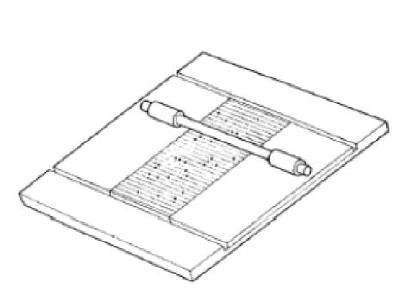
Before glass plates are coated with adsorbent, they must be carefully cleaned with laboratory detergent, using a test-tube brush to remove adhering particles, rinsed thoroughly with distilled water, placed in a suitable metal rack and dried in an oven. After the treatment with detergent solution the plates should only be handled by the edges or by the under-surface which is not to be coated with adsorbent. Failure to observe this precaution may result in the formation of a mechanically unstable layer which is liable to flaking due to grease spots on the glass surface. In severe cases of grease contamination, it may be necessary to use a chromic acid cleaning mixture. Small plates are conveniently prepared from microscope slides using a dipping technique; this operation is conducted in a fume cupboard. Slurry is prepared by the slow addition with shaking of 30g of adsorbent to 100ml of dry dichloromethane contained in a wide-necked capped bottle. A pair of microscope slides is held together and dipped into the slurry, slowly withdrawn and allowed to drain momentarily while held over the bottle. The slides are parted carefully and placed horizontally in a rack sited in a fume cupboard to dry for approximately 10 minutes. The surplus adsorbent is then removed by means of a razor blade drawn down the glass edges as shown in the figure.
Development of Chromatogram

- Take the glass chamber; add the prepared mobile phase. Add the filter paper for efficient saturation of the developing chamber.
- Take the activated glass plate to it and apply the starting material with the help of micropipette. Allow the starting material solution to dry.
- With the help of a second micropipette, apply synthesized product solution on the same activated plate at another location. Allow the synthesized product solution to dry.
- Put this plate in the developing chamber slowly without flushing.
- Allow the solvent front to run 80% of plate height.
- After achieving the desired target of solvent front, remove the plate and allow drying for 5 minutes.
- Put the dry plate in an iodine chamber or spray the suitable reagent to locate the solute spot.
- Calculate the Rf value of starting material and synthesized compound. Put the values on the observation table.
Result
The Rf value of starting material and synthesized compound are _____ and _____ which clears that the product was formed/not formed and have/does not have any starting material or other impurities.
Practical No 4: Melting point determination
Determination of Melting point of the sample
Figures
Sealing of capillary

Filling of capillary

Tying of capillary tube to thermometer

Determination of Melting point

Observation table
Sr. No | Name of sample | Start Point | End point | Melting point/Range |
1 |
|
|
|
|
2 |
|
|
|
|
3 |
|
|
|
|
4 |
|
|
|
|
Result
The melting point/range of the given sample was found to be –
1.
2.
3.
4.
Line page content
Aim
Determination of Melting point of the sample
Reference
Brain S. Furniss; Antony J. Hannford; Peter W. G. smith; Austin R. Tatchell. Vogel’s Textbook of practical organic chemistry, Pearson Education, New Delhi, 5th edition, page No –
Requirements
Theil’s tube, capillary tube, thermometer, thread, magnifying glass, black paper, match box
Chemical
Liquid praffin, dry sample powder
Theory
The change from solid to liquid state of a compound in heating is called melting and the temperature at which a solid in its pure form melts is called the melting point. Every pure solid has a characteristics melting point therefore determination of melting point helps in identification of the compound. Presence of impurities lowers the melting point of the solid. Thus, Melting point also serves as a criterion of purity of a compound.
A pure crystalline organic compound has, in general has definite and sharp melting point; that is, the melting point range (the difference between the temperature at which the collapse of the crystals is first observed and the temperature at which the sample becomes completely liquid) does not exceed about 0.5 °C. The presence of small quantities of miscible, or partially miscible, impurities will usually produce a marked increase in the melting point range and cause the commencement of melting to occur at a temperature lower than the melting point of the pure substance. In this case, melting point named as melting range. The melting point is therefore a valuable criterion of purity for an organic compound.
Procedure
The experimental method in most common use is to heat a small amount (about 1 mg) of the substance in a capillary tube inserted into a suitable melting point apparatus and to determine the temperature at which melting occurs. The capillary melting point tubes are prepared either from soft glass test tubes or from wide glass tubing.
Sealing of capillary tube
One end of each of the capillary tubes should be sealed by inserting it horizontally into the extreme edge of a small Bunsen flame for a few seconds, and the capillary tube rotated meanwhile; the formation of a glass bead at the end of the tube should be avoided.
Filling the capillary tube
The capillary tube is then filled as follows. About 25 mg of the dry substance is placed on a glass slide or upon a fragment of clean, porous porcelain plate and finely powdered with a clean metal or glass spatula, and then formed into a small mound. The open end of the capillary tube is pushed into the powder, ‘backing’ the latter, if necessary, with a spatula. The solid is then shaken down the tube by tapping the closed end on the bench or by gently drawing the flat side of a triangular file (a pocket nail file is quite effective) along the upper end of the tube. The procedure is repeated until the length of lightly packed material is 3-5 mm, and the outside of the tube is finally wiped clean.
Another method is rubbing the capillary tube on the rough surface. Due to vibrations, the sample settle at bottom. Both methods take time for travelling solid sample towards sealed end. The most time saving unreported method is use of condenser. The powder was tapped at the open end of capillary tube. This filled capillary tube is allowed to drop in between the condenser. Pickup the capillary tube, you will see that that solid sample has reached to sealed end.
Tying the capillary tube to thermometer
The filled melting point tube is attached to the lower end of the thermometer in such a way that the substance is at the level of the middle of the mercury bulb (which has previously been wetted with the bath liquid); the moistened capillary is then slid into position. The thermometer, with capillary attached, is inserted into the centre of the main tube of the Thiele apparatus.
Determination of melting point/range
The safest and most satisfactory bath liquids are the highly stable and heat-resistant Silicone oils. A cheaper alternative is medicinal paraffin; it has a low specific heat, is non-flammable and is non-corrosive, but it can only be safely heated to about 220°C; above this temperature it begins to decompose and becomes discoloured.
On heating the bent side-arm, the heated liquid circulates and raises the temperature of the sample in such a way that no stirring of the bath liquid is required. The melting point apparatus is heated comparatively rapidly with a small flame until the temperature of the bath is within 15°C of the melting point of the substance, and then slowly and regularly at the rate of about 2°C per minute until the compound melts completely. The temperature at which the substance commences to liquefy and the temperature at which the solid has disappeared, i.e. the melting point range, is observed. For a pure compound, the melting point range should not exceed.0.5-1 °C; it is usually less.
Result
The melting point/range of the given sample was found to be –
1.
2.
3.
4.
Practical No 5: Conventional 3-methyl-1-phenylpyrazol-5-one synthesis
Blank page content
Aim
Conventional synthesis of 3-methyl-1-phenyl pyrazol-5-one from ethylacetoacetate
Observation
- Weight of watch glass + phenyl hydrazine :_________g
- Weight of watch glass after transfer : ________g
- Weight of phenyl hydrazine taken (1-2) (SAY A) :_________g
- Molecular weight of phenyl hydrazine :_________ g
- Molecular weight of 3-methyl-1-phenyl pyrazol-5-one :_________ g
- Weight of container :_________ g
- Weight of Container + 3-methyl-1-phenyl pyrazol-5-one :_________ g
- Weight of synthesized 3-methyl-1-phenyl pyrazol-5-one :_________ g
Reaction

Reaction Mechanism

Calculation

Result

Line page content
Aim
Conventional synthesis of 3-methyl-1-phenyl pyrazol-5-one from ethylacetoacetate
Reference
Furniss B. S; Hannaford A. J.; Smith P.W. G; Tatchell A. R. Vogel’s textbook of practical organic chemistry, 5th edition, Pearson Publication, Page no 1150
Requirement
Apparatus
Evaporating dish, stirrer, measuring cylinder, thermometer, thiel’s tube
Chemical
Ethyl acetoacetate, phenylhydrazine, ether
Instrument
Balance, vacuum pump
Theory
The Knorr pyrazole synthesis is an organic reaction used to convert a hydrazine or its derivatives and a 1,3-dicarbonyl compound to a pyrazole using an acid catalyst. The mechanism begins with an acid catalysed imine formation, where in the case of hydrazine derivatives the attack can happen on either carbonyl carbon and result in two possible products. The other nitrogen of the hydrazine derivative then attacks the other carbonyl group which has also been protonated by the acid and forms a second imine group. This diimine compound gets deprotonated to regenerate the acid catalyst and provide the final pyrazole product.
Procedure
- Take the clean dry evaporating dish.
- To it add ___g, ___ml (50g, 49ml) of redistilled ethyl acetoacetate.
- To it add ___ml (36.5ml) of phenyl hydrazine.
- Heat this solution on boiling water bath for 2 hours with occasional shaking
- After 2 hours, cool the solution. The heavy reddish syrupy liquid is observed.
- Add ___ml (100ml) of diethyl ether to this liquid and stir the mixture vigorously.
- The syrupy liquid which is insoluble in ether get precipitate.
- Filter the product and at pump and wash it with ether to removed coloured impurities.
- Dry the product and determine the practical yield, melting point and check the purity of compound by performing TLC.
- Input all the analytical values in the table
Result
Practical No 6: Microwave 3-methyl-1-phenylpyrazol-5-one synthesis
Blank page content
Aim
Microwave assist synthesis of 3-methyl-1-phenyl pyrazol-5-one from ethyl acetoacetate
Observation
- Weight of watch glass + phenyl hydrazine :_________g
- Weight of watch glass after transfer : ________g
- Weight of phenyl hydrazine taken (1-2) (SAY A) :_________g
- Molecular weight of phenyl hydrazine :_________ g
- Molecular weight of 3-methyl-1-phenyl pyrazol-5-one :_________ g
- Weight of container :_________ g
- Weight of Container + 3-methyl-1-phenyl pyrazol-5-one :_________ g
- Weight of synthesized 3-methyl-1-phenyl pyrazol-5-one :_________ g
Reaction
Reaction Mechanism
Calculation
Result
Line page content
Aim
Microwave assist synthesis of 3-methyl-1-phenyl pyrazol-5-one from ethyl acetoacetate
Reference
Sharma S. V., Badami S., Venkateshwarlu L., Suresh B. Microwave technology in pharmaceutical chemistry practical: Synthesis of organic drugs. Indian Drugs, 40(8), 2003, page no 452
Requirement
Apparatus
Beaker, stirrer, measuring cylinder, thermometer, thiel’s tube
Chemical
Ethyl acetoacetate, phenylhydrazine, ether
Instrument
Microwave, Balance, vacuum pump
Theory
The Knorr pyrazole synthesis is an organic reaction used to convert a hydrazine or its derivatives and a 1,3-dicarbonyl compound to a pyrazole using an acid catalyst. The mechanism begins with an acid catalysed imine formation, where in the case of hydrazine derivatives the attack can happen on either carbonyl carbon or result in two possible products. The other nitrogen of the hydrazine derivative then attacks the other carbonyl group which has also been protonated by the acid and forms a second imine group. This diimine compound gets deprotonated to regenerate the acid catalyst and provide the final pyrazole product.
Procedure
- In a dry beaker, take ___g (1g) phenyl hydrazine
- To it add ___ml (1ml) of ethyl acetoacetate.
- Transfer the beaker to microwave
- Irradiate the content at 80% intensity for 6 minutes, 30 seconds.
- A reddish-brown syrupy liquid was obtained after cooling.
- Add ___ml (20ml) diethyl ether was added to it with vigorous stirring.
- A yellow colour compound slowly separated.
- Filter the product and at pump and wash it with ether to removed coloured impurities.
- Dry the product and determine the practical yield, melting point and check the purity of compound by performing TLC.
- Input all the analytical values in the table
Result
Practical No 7: Conventional Benzoyl glycine synthesis (Part -1 of 1,3-oxazole)
Blank page content
Aim
Conventional synthesis of Benzoyl glycine (Part -1 of 1,3-oxazole)
Observation
- Weight of watch glass + glycine : __________g
- Weight of watch glass after transfer : __________g
- Weight of glycine taken (1-2) (SAY A) : __________g
- Molecular weight of glycine :_________ g
- Molecular weight of benzoyl glycine :_________ g
- Weight of container :_________ g
- Weight of Container + benzoyl glycine :_________ g
- Weight of synthesized benzoyl glycine :_________ g
Reaction

Reaction Mechanism

Calculation

Result

Line page content
Aim
Conventional synthesis of Benzoyl glycine (Part -1 of 1,3-oxazole)
Reference
Furniss B. S; Hannaford A. J.; Smith P.W. G; Tatchell A. R. Vogel’s text book of practical organic chemistry, 5th edition, Pearson Publication, Page no 1156
Requirement
Apparatus
Conical Flask, Beaker, Measuring cylinder, thermometer, theil’s tube, capillary
Chemical
Glycine, acetic anhydride, distilled water
Instrument
Magnetic stirrer with bead, IR bulb, Suction pump
Theory
In acetylation reaction, acetyl group is substituted for the active hydrogen present on amino functional group or hydroxyl functional group. The most common acetylating agent used to achieve the desired task is acetic anhydride. Apart from acetic anhydride, acetyl chloride is also used as acetylating agent. Use of acetyl chloride is limited due to high reactivity towards water and alcohol. It immediately converted to acetic acid even in presence of moisture.
Procedure
- Weigh ____g (25g) of glycine and transfer to iodine flask.
- Add ____ml (250ml) of 10%w/v sodium hydroxide solution and start vigorous stirring.
- Add ____ml (45ml) of benzoyl chloride in 5 fractions. The second fraction was added after complete reaction of first fraction and so on. After each addition shake the flask vigorously.
- After complete addition, transfer the content to beaker. Add few ml of cold distilled water to iodine flask. Shake the content and transfer it to beaker.
- Add few gram of ice and add concentrated HCl till the solution is acidic to congo red paper (Red → blue).
- Cool the mixture in ice water and filter through suction and wash the product with cold water.
- Determine the practical yield, melting point and check the purity of compound by performing TLC.
- After completion of analytical evaluation, pack the compound, label it and submit it.
- Input all the analytical values in the table
Result
Practical No 8: Conventional 4-Benzylidene-2-phenyloxazol-5-one synthesis (Last part of 1,3-oxazole)
Blank page content
Aim
Conventional synthesis of 4-Benzylidene-2-phenyloxazol-5-one (Last part of 1,3-oxazole)
Observation
- Weight of watch glass + benzoylglycine :_________g
- Weight of watch glass after transfer : ________g
- Weight of benzoylglycine taken (1-2) (SAY A) :_________g
- Molecular weight of benzoylglycine :_________ g
- Molecular weight of 4-Benzylidene-2-phenyloxazol-5-one :_________ g
- Weight of container :_________ g
- Weight of Container + 4-Benzylidene-2-phenyloxazol-5-one:_________ g
8. Weight of synthesized 4-Benzylidene-2-phenyloxazol-5-one :_________ g
Reaction

Reaction Mechanism

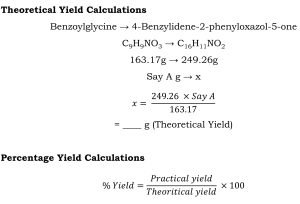
Calculation
Result

Line page content
Aim
Conventional synthesis of 4-Benzylidene-2-phenyloxazol-5-one (Last part of 1,3-oxazole)
Reference
Furniss B. S; Hannaford A. J.; Smith P.W. G; Tatchell A. R. Vogel’s text book of practical organic chemistry, 5th edition, Pearson Publication, Page no 1156
Requirement
Apparatus
Conical Flask, Beaker, Measuring cylinder, thermometer, theil’s tube, capillary
Chemical
Benzoyl glycine, acetic anhydride, anhydrous sodium acetate, ethanol
Instrument
IR bulb, Suction pump, Water bath
Theory
The Erlenmeyer reaction was first described in 1893 by Friedrich Gustav Carl Emil Erlenmeyer1 who condensed benzaldehyde with N-acetyl glycine in the presence of acetic anhydride and sodium acetate. The reaction goes via a Perkin condensation following the initial cyclization of the N-acetylglycine yielding the so-called Erlenmeyer azlactones.
In this process, the interaction between carbonyl compounds (aldehydes and ketones) and acylglycines or aroylglycines in the presence of acetic anhydride containing sodium acetate gives the corresponding 4-(alkylidene or arylidene)-2-oxazolin-5-one derivatives.
The reaction proceeds via the formation of 2-(alkyl or aryl)-5-oxazolones which undergo Perkin condensation with aromatic aldehydes to give the corresponding alkylidene or arylidene oxazolones.
Procedure
- Weigh ____g (45g) of benzoylglycine and transfer to RBF which already content porcelain bead.
- Add ____ml (26ml) of redistilled benzaldehyde to iodine flask.
- Add ____g (20.5) of anhydrous sodium acetate to iodine flask
- Add ____ml (71.5ml) of acetic anhydride to iodine flask.
- Keep the flask on hot plate and heat till solution is formed.
- As soon as solution is formed, the flask was transfer to boiling water bath
- Boil the solution for 2 hours
- After 2 hours, add ____ml (100ml) of ethanol slowly.
- Allow the mixture to stand overnight. Filter the crystalline product via suction.
- Wash the product with two ___ml (25ml) portion of boiling water. Dry at 100°C
- Determine the practical yield, melting point and check the purity of compound by performing TLC.
- After completion of analytical evaluation, pack the compound, label it and submit it.
- Input all the analytical values in the table
Result
Practical No 9: Conventional Benzimidazole synthesis
Blank page content
Aim
Conventional synthesis of Benzimidazole
Observation
Observations
- Weight of watch glass + o-phenylene diamine :_________ g
- Weight of watch glass after transfer :_________ g
- Weight of o-phenylene diamine taken for synthesis :_________ g (Say A)
- Molecular weight of o-phenylene diamine :_________ g
- Molecular weight of Benzimidazole :_________ g
- Weight of container :_________ g
- Weight of Container + Benzimidazole :_________ g
- Weight of synthesized Benzimidazole :_________ g
Reaction

Reaction Mechanism

Calculation

Result

Line page content
Aim
Conventional synthesis of Benzimidazole
Reference
- Furniss B. S., Hannaford A.J., Smith P.W.G., Tatchell A.R., Vogel’s Textbook of Practical Organic Chemistry, Fifth Ed, Longman Sci and Technical, 1989, page 1162.
- Mann F. G., Saunders B. C., Practical Organic chemistry, 4th edition, pearson publication, page No 301
Requirement
Apparatus
RBF, Condenser, Beaker, Measuring cylinder, Water bath, Funnel
Chemical
Formic acid, o-phenylenediamine, Sodium hydroxide, water
Instrument
Suction filtration assembly, IR Lamp, Weighing balance
Theory
The synthesis of benzimidazole is based on condensation reaction of diamine with formic acid. The amine functional groups act as a nucleophile. The electron of this nucleophile is shared with carbocation present in formic acid. This sharing of electrons leads to cyclization and formation of Benzimidazole. The reaction is catalyzed by sodium hydroxide solution.
Procedure
- In a clean dry RBF, take ____g (27) of o-phenylene diamine and to it add ____g (17.5g) of 90% formic acid solution.
- Heat the mixture on water bath for 2 hours. After 2 hours, cool the mixture.
- After through cooling, add 10% sodium hydroxide solution till the solution is alkaline to litmus.
- Filter the crude benzimidazole at pump and wash it with ice-cold mixture.
- Recrystallization was done by hot water with decolourizing carbon
- Determine the product yield, % yield, melting point and TLC and report the date in the table.
Application of synthesis
Benzimidazole is used for the synthesis of various drugs belong to
- Antihistaminic (Astemiazole)
- Analgesics (Benzitramide)
- Anti-hypertensive (Candesartan)
- Anti-allergic (Emedastine)
- Anti-ulcer (Lansoprazole)
- Antiviral (Maribavir),
- Anthelmintics (Albendazole) etc
Result
Practical No 10: Conventional 2,3-diphenyl quinoxaline synthesis
Blank page content
Aim
Conventional synthesis of 2,3-diphenyl quinoxaline
Observation
- Weight of watch glass + Benzil : __________g
- Weight of watch glass after transfer : __________g
- Weight of Benzil taken (1-2) (SAY A) : __________g
- Molecular weight of Benzil :_________ g
- Molecular weight of 2,3-diphenyl quinoxaline :_________ g
- Weight of container :_________ g
- Weight of Container + 2,3-diphenyl quinoxaline :_________ g
- Weight of synthesized 2,3-diphenyl quinoxaline :_________ g
Reaction

Reaction Mechanism

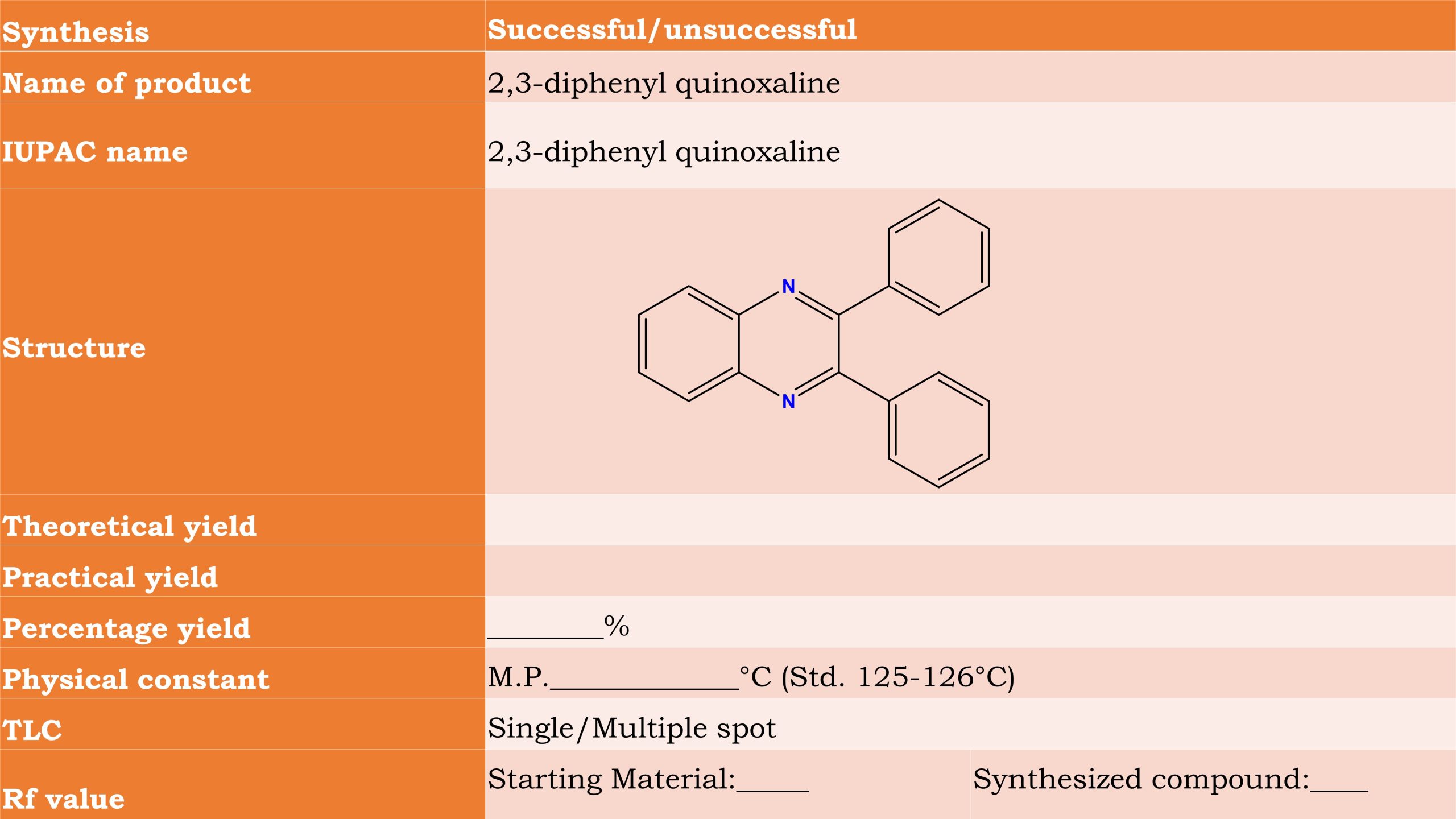
Calculation

Result
Line page content
Aim
Conventional synthesis of 2,3-diphenyl quinoxaline
Reference
Furniss B. S; Hannaford A. J.; Smith P.W. G; Tatchell A. R. Vogel’s text book of practical organic chemistry, 5th edition, Pearson Publication, Page no 1190
Requirement
Apparatus
Beaker, Stirrer, measuring cylinder, water bath
Chemical
o-diphenylene diamine, ethanol, benzil
Instrument
Balance, vacuum pump
Theory
This synthesis is based on condensation reaction between benzil and o-phenylene diamine
Procedure
- In the dry beaker, take ___g (2.1g) of
- Add ____ml (8ml) of rectified spirit
- In another beaker take ____g (1.1g) of o-phenylene diamine and dissolved it in ____ml (8ml) of rectified spirit
- Pour the solution of o-phenylene diamine to the solution of benzil.
- Warm the resulting solution on water bath for 30 minutes.
- Add water till a slight cloudiness appear and allow the solution to cool.
- Collect the solid by vacuum filtration and wash with ice-cold water.
- Determine the practical yield, melting point and check the purity of compound by performing TLC.
- After completion of analytical evaluation, pack the compound, label it and submit it.
- Input all the analytical values in the table
Result
Practical No 11: Microwave 2,3-diphenyl quinoxaline synthesis
Blank page content
Aim
Microwave synthesis of 2,3-diphenyl quinoxaline
Observation
- Weight of watch glass + Benzil : __________g
- Weight of watch glass after transfer : __________g
- Weight of Benzil taken (1-2) (SAY A) : __________g
- Molecular weight of Benzil :_________ g
- Molecular weight of 2,3-diphenyl quinoxaline :_________ g
- Weight of container :_________ g
- Weight of Container + 2,3-diphenyl quinoxaline :_________ g
- Weight of synthesized 2,3-diphenyl quinoxaline :_________ g
Reaction
Reaction Mechanism
Calculation
Result
Line page content
Aim
Microwave synthesis of 2,3-diphenyl quinoxaline
Reference
Sharma S. V., Badami S., Venkateshwarlu L., Suresh B. Microwave technology in pharmaceutical chemistry practical: Synthesis of organic drugs. Indian Drugs, 40(8), 2003, page no 452
Requirement
Apparatus
Beaker, Stirrer, measuring cylinder, water bath
Chemical
o-diphenylene diamine, ethanol, benzil
Instrument
Microwave, Balance, vacuum pump
Theory
This synthesis is based on condensation reaction between benzil and o-phenylene diamine
Procedure
- In a dry moltar and pestle take ___g (1g) of
- To it add ____g (0.5g) of o-phenylene diamine
- Transfer the solid content in a beaker.
- Transfer the beaker to microwave
- Irradiate the solid at 100% intensity for 90 seconds.
- The brown liquid was obtained in hot conditions which after cooling get solidify.
- Dissolve the solid in methanol and add a pinch of activated charcoal
- Boil the solution on water bath and filter in hot condition
- Keep the clear filtrate in ice bath.
- Crystal of obtained
- Add ____ml (8ml) of rectified spirit
- Collect the solid by vacuum filtration and wash with ice-cold water.
- Determine the practical yield, melting point and check the purity of compound by performing TLC.
- After completion of analytical evaluation, pack the compound, label it and submit it.
- Input all the analytical values in the table
Result
Practical No 12: Microwave Benzocaine synthesis
Blank page content
Aim
Microwave synthesis of Benzocaine
Observation
- Weight of watch glass + p-amino benzoic acid :_________ g
- Weight of watch glass after transfer :_________ g
- Weight of p-amino benzoic acid taken for synthesis :_________ g (Say A)
- Molecular weight of p-amino benzoic acid :_________ g
- Molecular weight of Benzocaine :_________ g
- Weight of container :_________ g
- Weight of Container + Benzocaine :_________ g
- Weight of synthesized Benzocaine :_________ g
Reaction

Reaction Mechanism

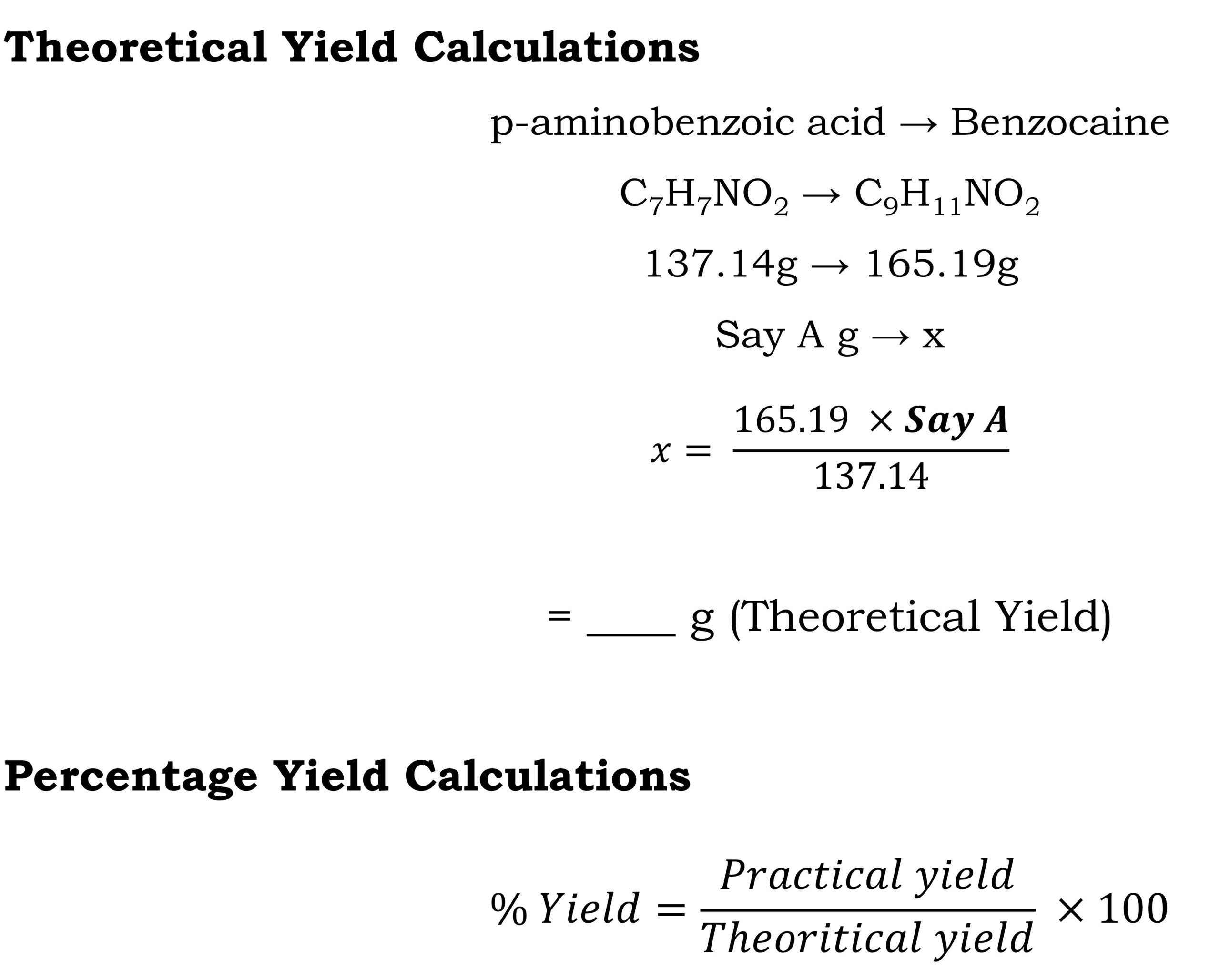
Calculation
Result

Line page content
Aim
Microwave synthesis of Benzocaine
Reference
Sharma S. V., Badami S. Microwave technology in pharmaceutical chemistry practical: Synthesis of organic drugs. 40(08), 2003, page No 451
Requirement
Apparatus
Conical flask, funnel, beaker, microscopic slide
Chemical
p-amino benzoic acid, ethanol, Concentrated H2SO4, Sodium carbonate, silica gel G
Instrument
Microwave instrument, vaccum filtration assembly, Weighing balance
Theory
The synthesis of benzocaine is based on the esterification reaction. The acid part of benzoic acid undergoes condensation with ethanol to form benzocaine
Procedure
- In a clean dry flask, Add ___g (0.5g) of p-amino benzoic acid
- To it add place ____ml (6ml) of dry ethanol and mix the content.
- Add drop wise, ____ml (1ml) of concentrated sulphuric acid and mix the content.
- Transfer the flask to microwave. Cover the flask by funnel.
- A beaker containing water was keep near the reaction vessel to provide sink condition.
- Irradiate the solution with 20% intensity for 6 minutes.
- The pale brown colour liquid was obtained. It was cooled in water.
- Add the 10% sodium carbonate solution till the pH 9 is achieved.
- The white precipitate is obtained.
- Filter the precipitate through suction.
- Dry the compound in air
- Determine the practical yield, melting point and check the purity of compound by performing TLC.
- After completion of analytical evaluation, pack the compound, label it and submit it.
- Input all the analytical values in the table
Result
Practical No 13: Conventional Phenytoin synthesis
Blank page content
Aim
Conventional synthesis of Phenytoin
Observation
- Weight of watch glass + Benzil :_________ g
- Weight of watch glass after transfer :_________ g
- Weight of Benzil taken for synthesis :_________ g (Say A)
- Molecular weight of Benzil :_________ g
- Molecular weight of phenytoin :_________ g
- Weight of container :_________ g
- Weight of Container + phenytoin :_________ g
- Weight of synthesized phenytoin :_________ g
Reaction

Reaction Mechanism

Calculation

Result

Line page content
Aim
Conventional synthesis of Phenytoin
Reference
- Furniss B. S., Hannaford A.J., Smith P.W.G., Tatchell A.R., Vogel’s Textbook of Practical Organic Chemistry, Fifth Ed, Longman Sci and Technical, 1989, page 1045.
- Mann F. G., Saunders B. C., Practical Organic chemistry, 4th edition, pearson publication, page No 234
Requirement
Apparatus
RBF, Condenser, Beaker, Measuring cylinder, Water bath, Funnel
Chemical
Benzil, Sodium hydroxide, Concentrated HCl, Urea, Water
Instrument
Suction filtration assembly, IR Lamp, Weighing balance
Theory
The synthesis of benzil is based on 1,2 shift type of reaction resembles to benzillic acid. Sodium hydroxide acts as a catalyst. Ethanol is used to dissolve benzil.
Procedure
- In a clean dry RBF, take ____g (5.3g) of Benzil. To it add ____g (3.0g) of urea.
- Add ____ml (15ml) of 30% aqueous sodium hydroxide solution.
- To it add ___ml (75ml) of ethanol. Add a piece of procelin and transfer the RBF to water bath.
- Attach the condenser, and start the reflux on electric heating mantle for atleast two hours
- After two hours, cool the content and pour the reaction mixture in to ____ml (125ml) water and mix.
- Allow to stand for 15 minutes and filter the precipitate under suction to remove insoluble debris.
- Acidify the filtrate with Conc. HCl. Cool in ice and filter immediately via suction.
- Determine the product yield, % yield, melting point and TLC and report the date in the table.
Result
Practical No 14: Microwave Phenytoin synthesis
Blank page content
Aim
Microwave synthesis of Phenytoin
Observation
- Weight of watch glass + Benzil :_________ g
- Weight of watch glass after transfer :_________ g
- Weight of Benzil taken for synthesis :_________ g (Say A)
- Molecular weight of Benzil :_________ g
- Molecular weight of phenytoin :_________ g
- Weight of container :_________ g
- Weight of Container + phenytoin :_________ g
- Weight of synthesized phenytoin :_________ g
Reaction
Reaction Mechanism
Calculation
Result
Line page content
Aim
Microwave synthesis of Phenytoin
Reference
Mukesh K. Nagar*, Karishma R. Waghmare2, P.N. Dhabale, Pradeep D. Chanekar and Suresh Bhatia. Microwave Assisted Synthesis and Characterization of Phenytoin. Asian J. Research Chem. 4(4): April, 2011; Page 619-620.
Requirement
Apparatus
RBF, Condenser, Beaker, Measuring cylinder, Water bath, Funnel
Chemical
Benzil, Sodium hydroxide, Concentrated HCl, Urea, Water
Instrument
Microwave Suction filtration assembly, IR Lamp, Weighing balance
Theory
The synthesis of benzil is based on 1,2 shift type of reaction resembles to benzillic acid. Sodium hydroxide acts as a catalyst. Ethanol is used to dissolve benzil.
Procedure
- In a clean dry conical flask, take ____g (0.53g) of Benzil.
- To it add ____g (0.3g) of urea.
- Add ____ml (3ml) of 30% aqueous sodium hydroxide solution.
- To it add ___ml (3ml) of methanol. Put the funnel on the conical flask.
- Irradiate the solution at 40% intensity for 4 minutes.
- Mixture starts boiling after 30 seconds and white solid get separated.
- After 4 minutes, cool the content and pour the reaction mixture in to ____ml (30ml) water and mix.
- Allow to stand for 15 minutes and filter the precipitate to remove insoluble debris.
- Acidify the filtrate with Conc. HCl. Cool in ice and filter immediately via suction.
- Determine the product yield, % yield, melting point and TLC and report the date in the table
Result
Practical No 15: Ibuprofen Assay
Blank page content
Aim
Assay of Ibuprofen
Observation
- Weight of watch glass + oxalic acid :________ g
- Weight of watch glass after transfer :________ g
- Weight of oxalic acid taken for standardization :_____ g/100ml
- Weight of oxalic acid for titration (SayA) :______ g/10ml
- Weight of watch glass + NaOH :________ g
- Weight of watch glass after transfer :________ g
- Weight of sodium hydroxide taken :________ g
- Weight of watch glass + 20 tablets :________ g
- Weight of watch glass after transfer :________ g
- Weight of 20 tablets (Say B) :________ g
- Average weight of one tablet (Say C) (Say B/20) :________ g
- Weight of watch glass + ibuprofen powder :________ g
- Weight of watch glass after transfer :________ g
- Weight of ibuprofen powder taken for assay (SayD) :________ g
- Label claim (Say E) :________ g
Observation table
Sr. No. | Content in flask (ml) | Burette reading (ml) | Average burette reading (ml) |
01 | 10ml of oxalic acid |
| Say F |
02 |
| ||
03 |
| ||
04 | Assay |
| |
05 | Blank |
| |
06 | Actual reading | Assay – Blank | Say G |
Reaction

Calculation
Fator calculation
From the reaction it is seen that
1mole of NaOH ≡ 1 mole of ibuprofen (C13H18O2)
40g of NaOH ≡ 206.29g of C13H18O2
Applying the definition of molarity, we get
1000ml of 1M NaOH ≡ 206.29g of C13H18O2
1ml of 1M NaOH ≡ 0.2063g of C13H18O2
1ml of 0.1M NaOH ≡ 0.02063g of C13H18O2
Standarization of Sodium hydroxide
Mol. weight of NaOH: 40.0g Equivalent weight of NaOH: 40.0g
Mol. weight of Oxalic acid: 126g Equivalent weight of oxalic acid: 63g
Mol. weight of Ibuprofen: 206.29g

Assay of Ibuprofen

% Purity of tablet

Result
- The Molarity of prepared sodium hydroxide was found to be _____ (Say H)
- The percent content of ibuprofen was found to be _______ % (Say K)
Line page content
Aim
Assay of Ibuprofen
Reference
Indian Pharmacopeia, Published by Indian Pharmacopeia Commission, Sector 3, Gaizabad, 8th Edition, volume-II, Page No ____
Requirement
Apparatus
Conical flask, Burette, Burette stand, Funnel, Volumetric flask (100ml), Beaker, Pipette (1ml), Measuring Cylinder (10ml)
Chemical
sodium hydroxide, oxalic acid/ potassium hydrogen pthalate, ibuprofen tablet/powder, Phenolphthalein indicator, Distilled water, ethanol, chloroform
Instrument
Weighing balance, Hot plate/Heating Mantle
Theory
Titration is the process of adding and then measuring the actual volume of titrant consumed in the assay.
Neutralization titration is the process in which acid or base is neutralized by a base or acid and the end point is determined either by visual effect or by instrument (potentiometer/pH Meter). Thus, according to this there are four types of titration can be done. They are as follows-
- Titration of strong acid with strong base
- Titration of weak acid with strong base
- Titration of strong acid with weak base
- Titration of weak acid with weak base
Thus, depending on the type of titration neutralization curve will be obtained and the determination of equivalence point can be used to determine the concentration of analyte.
Principle
The assay of ibuprofen is based on the direct type of titration belonging to the class of titration of a weak acid with strong base. In this titration, ibuprofen is a weak acid and acts as an analyte whereas sodium hydroxide is a strong base and act as titrant. Ethanol has been added to increase the solubility of ibuprofen, since the solubility of ibuprofen in water is poor. Chloroform is used to extract ibuprofen from the tablet matrix.
The indicator that has been chosen for this titration is phenolphthalein since the equivalence point of the titration approaches near 8.7 and indicator has the pH range of 8.3 to 10.0 which makes it suitable indicator for this titration.
Importance of chemicals used in this assay
- Ibuprofen – Ibuprofen is used as analyte
- Sodium hydroxide – Sodium hydroxide is used as titrant
- Ethanol – To soluble ibuprofen and also miscible with water
- Chloroform – Chloroform is used to extract ibuprofen from the tablet matrix
- Phenolphthalein indicator – Phenolphthalein acts as indicator.
Precautions
- Air bubble from the burette should be removed. If air bubble is kept then there will be incorrect estimation of aspirin content.
- Addition of sodium hydroxide from burette should be slow with continuous stirring. Faster addition or slow addition without stirring will provide pre-mature end point causing error while determining the % purity of ibuprofen.
- The 0.1M sodium hydroxide solution should be freshly prepared. While preparing the solution the distilled water should be freshly boiled and cooled. If the distilled water is not boiled or solution is not freshly prepared, then molarity of sodium hydroxide will decrease due to reaction with bicarbonic acid. The latter acid is formed due to absorption of atmospheric carbon dioxide in water.
Preparation of reagent
0.1M Sodium hydroxide solution
Weigh 0.4g of sodium hydroxide and dissolved in approximately 50ml of carbon dioxide free water and dissolve the content. After complete dissolution of sodium hydroxide, the volume was made up to 100ml with carbon dioxide free distilled water and volumetric flask is corked to prevent entry of carbon dioxide.
Procedure
- Clean all the apparatus required for the titration.
- ____g of sodium hydroxide was weighed and was dissolved in 50ml of carbon dioxide free distilled water. After complete dissolution the volume of the solution was made up to 100ml with carbon dioxide free distilled water.
- ___g of oxalic acid was weighed and was transferred to 100ml volumetric flask. To it 50ml of distilled water was added and after the dissolution of solid, volume was made up to 100ml with distilled water.
- Fill the burette with the prepared sodium hydroxide solution and air bubble was removed and the volume was adjusted to mark.
- 10ml of oxalic acid solution was taken into a conical flask to it 2 drops of phenolphthalein indicator was added and the solution was titrated with sodium hydroxide solution until light pink colour was obtained.
- The burette reading was noted and step was repeated for two more reading. All the readings were tabulated in the table and the molarity of sodium hydroxide solution was calculated.
- ____g (0.5g) of ibuprofen powder was weighed and transfer to iodine flask.
- To it add ___ml (60ml) of chloroform and was shaken vigorously for 15 minutes.
- Filter the suspension and collect the filtrate.
- Evaporate the filtrate at room temperature and collect the solid.
- Dissolve the solid in ___ ml (100ml) of ethanol previously neutralized with sodium hydroxide.
- Add 2 drops of phenolphthalein indicator.
- Titrate the resulting solution with the sodium hydroxide solution until the light pink colour is observed.
- Note the burette reading and inserted the value in observation table.
- Performed the blank determination by repeating steps 11 to 13 without adding ibuprofen powder. The burette reading was noted and was tabulated in the table.
- Calculate the percent purity of ibuprofen for given tablet and report in result
Result
- The Molarity of prepared sodium hydroxide was found to be _____ (Say H)
- The percent content of ibuprofen was found to be _______ % (Say K)
Practical No 16: Aspirin Assay
Blank page content
Aim
Assay of Aspirin
Observation
- Weight of watch glass + aspirin powder : g
- Weight of watch glass after transfer : g
- Weight of aspirin powder taken (1-2) (Say A) : g
- Weight of watch glass + oxalic acid : g
- Weight of watch glass after transfer : g
- Weight of oxalic acid taken (4-5) (Say B) : g/100ml
- Weight of oxalic acid taken (Say C) : g/10ml
- Weight of watch glass + NaOH : g
- Weight of watch glass after transfer : g
- Weight of NaOH taken (8-9) : g/100ml
- Volume of Hydrochloric acid taken : ml
Observation table
Sr. No. | Content in flask (ml) | Burette reading (ml) | Average burette reading (ml) |
01 | 10ml of oxalic acid |
| Say D |
02 |
| ||
03 |
| ||
04 | Assay |
| |
05 | Blank |
| |
06 | Actual reading | Blank – Assay | Say E |
Reaction

Calculations
Factor calculations
From the reaction it is seen that
1mole of NaOH ≡ 1 mole of HCl
But 2 moles of NaOH is required to degrade 1 mole of aspirin, thus
2 moles of NaOH ≡ 1mole of Aspirin (C9H8O4)
Thus, it can be said that
2 moles of NaOH ≡ 2 Mole of HCl ≡ 1mole of Aspirin (C9H8O4)
Thus, 2 moles of NaOH ≡ 1 mole of C9H8O4
1 moles of NaOH ≡ 0.5 mole of C9H8O4
40g of NaOH ≡ 90g of C9H8O4
Multiplying the whole equation by 5, we get
200g of NaOH ≡ 450g of C9H8O4
Applying the definition of molarity, we get
1000ml of 5M NaOH ≡ 450g of C9H8O4
1ml of 5M NaOH ≡ 0.450g of C9H8O4
1ml of 0.5M NaOH ≡ 0.0450g of C9H8O4
Factor:
1ml of 0.5M NaOH ≡ 0.0450g of C9H8O4
Standardization of Sodium hydroxide
Mol. weight of NaOH: 40.0g Equivalent weight of NaOH: 40.0g
Mol. weight of Oxalic acid: 126g Equivalent weight of oxalic acid: 63g
Mol. weight of Aspirin: 180g

Assay of Aspirin
% Purity of aspirin


Result
- The Molarity of prepared sodium hydroxide was found to be Say F
- The percent content of aspirin was found to be Say J %.
Line page content
Aim
Assay of Aspirin
Reference
Indian Pharmacopeia, Published by Indian Pharmacopeia Commission, Sector 3, Gaizabad, 8th Edition, volume-II, Page No 1277
Requirement
Apparatus
Conical flask, Burette, Burette stand, Funnel, Volumetric flask (100ml), Beaker, Pipette (1ml), Measuring Cylinder (10ml)
Chemical
Concentrated Hydrochloric acid (HCl), sodium hydroxide, oxalic acid/ potassium hydrogen pthalate, aspirin powder, Methyl red Indicator, Phenolphthalein indicator, Phenol red indicator, Distilled water
Instrument
Weighing balance, Hot plate/Heating Mantle
Theory
Back titration means the titration that has been done in reverse, i.e. titration is done with the standard known excess reagent which is used to react with the analyte.
A back titration is useful if the endpoint of the reverse titration is easier to identify than the endpoint of the normal titration. Back titrations are also useful if the reaction between the analyte and the titrant is very slow, or when the analyte is in a non-soluble solid.
Principle
The titration of aspirin with sodium hydroxide follows the graph of a weak acid with strong base. Aspirin get degrade to acetic acid and salicyclic acid in acidic as well as basic pH. Formations of two acids make direct titration difficult. Hence assay of aspirin is done by back titration. Aspirin is reacted with a known excess quantity of sodium hydroxide. The unreacted sodium hydroxide is back titrated with hydrochloric acid. At basic pH, phenol red has red colour but at equivalence point the red colour changes to yellow indicates end of titration.
Importance of Chemicals
Aspirin – Aspirin is used as analyte
Sodium hydroxide – Sodium hydroxide is used to degraded aspirin to sodium salicylate and sodium acetate
Hydrochloric acid – Hydrochloric acid is used for estimation of unreacted sodium hydroxide
Heat – Hot sodium hydroxide is added to accelerate the degradation of aspirin.
Phenol red indicator
Phenol red acts as weak acid which helps to neutralize the basic environment that has been created by the hydrolysis of sodium acetate and sodium salicylate. At basic pH it shows red colour where as at equivalence point it shows yellow colour which help analyst to detect end point very accurately.
Precautions while performing assay
- Air bubble from the burette should be removed. If air bubble is kept then there will be incorrect estimation of aspirin content.
- Addition of hydrochloric acid from burette should be slow with continuous stirring. Faster addition of slow addition without stirring will provide pre-mature end point causing error while determining the % purity of aspirin.
- The 0.5M sodium hydroxide solution should be freshly prepared. While preparing the solution the distilled water should be freshly boiled and cooled. If the distilled water is not boiled or solution is not freshly prepared then molarity of sodium hydroxide will decrease due to reaction with bicarbonic acid. The latter acid is formed due to absorption of atmospheric carbon dioxide in water.
Preparation of Reagent
0.5M hydrochloric acid
Dissolve 4.25ml concentrated hydrochloric acid in approximately 50ml of distilled water and stir the solution. Finally, make up the volume up to 100ml with distilled water.
0.5M Sodium hydroxide solution
Weigh 2g of sodium hydroxide and dissolved in approximately 50ml of carbon dioxide free water and dissolve the content. After complete dissolution of sodium hydroxide the volume was made up to 100ml with carbon dioxide free distilled water and volumetric flask is corked to prevent entry of carbon dioxide.
Procedure
- Clean all the apparatus required for the titration.
- ___ml of hydrochloric acid was a pipette out and was dissolved in 50ml of distilled water. The solution was uniformly mixed and volume was made up to 100ml with distilled water.
- ____g of sodium hydroxide was weighed and was dissolved in 50ml of carbon dioxide free distilled water. After complete dissolution the volume of the solution was made up to 100ml with carbon dioxide free distilled water.
- ___g of oxalic acid was weighed and was transferred to 100ml volumetric flask. To it 50ml of distilled water was added and after the dissolution of solid, volume was made up to 100ml with distilled water.
- Fill the burette with the prepared sodium hydroxide solution and air bubble was removed and the volume was adjusted to mark.
- 10ml of oxalic acid solution was taken into a conical flask to it 2 drops of phenolphthalein indicator was added and the solution was titrated with sodium hydroxide solution until light pink colour was obtained.
- The burette reading was noted and step was repeated for two more reading. All the readings were tabulated in the table and the molarity of sodium hydroxide solution was calculated.
- The burette was washed with distilled water and dried. To this burette add prepared 0.5M hydrochloric acid solution and air bubble was removed. The volume was adjusted to required mark.
- ____mg of aspirin powder was weighed and transfer to conical flask. To it add 30ml of standardized sodium hydroxide solution. Warm the solution and kept the warmed solution aside for 10 minutes to complete the reaction.
- The solution was allowed to cool and to it add 2 drops of phenol red indicator.
- Titrate the resulting solution with the hydrochloric acid solution until the red colour changes to yellow. Burette reading was determined and tabulated in the table.
- Performed the blank determination by repeating steps 9 to 11 without adding aspirin powder. The burette reading was noted and was tabulated in the table.
Result
- The Molarity of prepared sodium hydroxide was found to be Say F
- The percent content of aspirin was found to be Say J %.
Practical No 17: Furosemide tablet Assay
Blank page content
Aim
Assay of Furosemide tablet
Observation
- Weight of watch glass + oxalic acid :________ g
- Weight of watch glass after transfer :________ g
- Weight of oxalic acid taken for standardization :________ g/100ml
- Weight of oxalic acid for titration (SayA) :________ g/10ml
- Weight of watch glass + NaOH :________ g
- Weight of watch glass after transfer :________ g
- Weight of sodium hydroxide taken :________ g
- Weight of watch glass + 20 tablets :________ g
- Weight of watch glass after transfer :________ g
- Weight of 20 tablets (Say B) :________ g
- Average weight of one tablet (Say C) (Say B/20) :________ g
- Weight of watch glass + frusemide powder :________ g
- Weight of watch glass after transfer :________ g
- Weight of frusemide powder taken for assay (SayD) :________ g
- Label claim (Say E) :________ g
Observation table
Sr. No. | Content in flask (ml) | Burette reading (ml) | Average burette reading (ml) |
01 | 10ml of oxalic acid |
| Say F |
02 |
| ||
03 |
| ||
04 | Assay |
| |
05 | Blank |
| |
06 | Actual reading | Assay – Blank | Say G |
Reaction

Calculation
Factor calculation
From the reaction it is seen that
1mole of NaOH ≡ 1 mole of furosemide (C12H11ClN2O5S)
40g of NaOH ≡ 330.74g of C12H11ClN2O5S
Applying the definition of molarity, we get
1000ml of 1M NaOH ≡ 330.74g of C12H11ClN2O5S
1ml of 1M NaOH ≡ 0.3307g of C12H11ClN2O5S
1ml of 0.1M NaOH ≡ 0.03307g of C12H11ClN2O5S
1ml of 0.1M NaOH ≡ 0.03307g of C12H11ClN2O5S
Standardization of sodium hydroxide
Mol. weight of NaOH: 40.0g Equivalent weight of NaOH: 40.0g
Mol. weight of Oxalic acid: 126g Equivalent weight of oxalic acid: 63g
Mol. weight of Furosemide: 330.74g
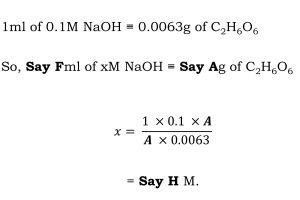
Assay of Furosemide

% Purity of furosemide tablet
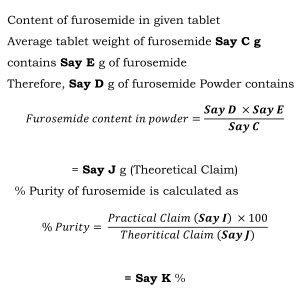
Result
- The Molarity of prepared sodium hydroxide was found to be Say H
- The percent content of furosemide was found to be Say K %.
Line page content
Aim
Assay of Furosemide tablet
Reference
Indian Pharmacopeia, Published by Indian Pharmacopeia Commission, Sector 3, Gaizabad, 8th Edition, volume-II, Page No ____
Requirement
Apparatus
Conical flask, Burette, Burette stand, Funnel, Volumetric flask (100ml), Beaker, Pipette (1ml), Measuring Cylinder (10ml)
Chemical
sodium hydroxide, oxalic acid/ potassium hydrogen pthalate, furosemide tablet/powder, Phenolphthalein indicator, Distilled water, methanol
Instrument
Weighing balance, Hot plate/Heating Mantle
Theory
Titration is the process of adding and then measuring the actual volume of titrant consumed in the assay.
Neutralization titration is the process in which acid or base is neutralized by a base or acid and the end point is determined either by visual effect or by instrument (potentiometer/pH Meter). Thus, according to this there are four types of titration can be done. They are as follows-
- Titration of strong acid with strong base
- Titration of weak acid with strong base
- Titration of strong acid with weak base
- Titration of weak acid with weak base
Thus, depending on the type of titration neutralization curve will be obtained and the determination of equivalence point can be used to determine the concentration of analyte.
Principle
The assay of furosemide is based on the direct type of titration belonging to the class of titration of a weak acid with strong base. In this titration, furosemide is a weak acid and acts as an analyte whereas sodium hydroxide is a strong base and act as titrant. Methanol has been added to increase the solubility of furosemide, since the solubility of furosemide in water is poor. The indicator that has been chosen for this titration is phenolphthalein since the equivalence point of the titration approaches near 8.7 and indicator has the pH range of 8.3 to 10.0 which makes it suitable indicator for this titration.
Importance of chemicals used in this assay
Furosemide – Furosemide is used as analyte
Sodium hydroxide – Sodium hydroxide is used as titrant
Methanol – To soluble furosemide and miscible with water
Phenolphthalein indicator – Phenolphthalein acts as an indicator.
Precautions while performing assay
- Air bubble from the burette should be removed. If air bubble is kept then there will be incorrect estimation of aspirin content.
- Addition of sodium hydroxide from burette should be slow with continuous stirring. Faster addition or slow addition without stirring will provide pre-mature end point causing error while determining the % purity of furosemide.
- The 0.5M sodium hydroxide solution should be freshly prepared. While preparing the solution the distilled water should be freshly boiled and cooled. If the distilled water is not boiled or solution is not freshly prepared then molarity of sodium hydroxide will decrease due to reaction with bicarbonic acid. The latter acid is formed due to absorption of atmospheric carbon dioxide in water.
Preparation of reagent
0.1M Sodium hydroxide solution
Weigh 0.4g of sodium hydroxide and dissolve in approximately 50ml of carbon dioxide free water and dissolve the content. After complete dissolution of sodium hydroxide the volume was made up to 100ml with carbon dioxide free distilled water and volumetric flask is corked to prevent entry of carbon dioxide.
Procedure
- Clean all the apparatus required for the titration.
- ____g of sodium hydroxide was weighed and was dissolved in 50ml of carbon dioxide free distilled water. After complete dissolution the volume of the solution was made up to 100ml with carbon dioxide free distilled water.
- ___g of oxalic acid was weighed and was transferred to 100ml volumetric flask. To it 50ml of distilled water was added and after the dissolution of solid, volume was made up to 100ml with distilled water.
- Fill the burette with the prepared sodium hydroxide solution and air bubble was removed and the volume was adjusted to mark.
- 10ml of oxalic acid solution was taken into a conical flask to it 2 drops of phenolphthalein indicator was added and the solution was titrated with sodium hydroxide solution until light pink colour was obtained.
- The burette reading was noted and step was repeated for two more reading. All the readings were tabulated in the table and the molarity of sodium hydroxide solution was calculated.
- ____g of furosemide powder was weighed and transfer to conical flask. To it add 12ml of methanol previously neutralized with sodium hydroxide.
- Add 2 drops of phenolphthalein indicator.
- Titrate the resulting solution with the sodium hydroxide solution until the light pink colour is observed.
- Note the burette reading and inserted the value in observation table.
- Performed the blank determination by repeating steps 7 to 9 without adding furosemide powder. The burette reading was noted and was tabulated in the table.
- Calculate the percent purity of furosemide for given tablet and report in result
Result
- The Molarity of prepared sodium hydroxide was found to be Say H
- The percent content of furosemide was found to be Say K %.
Practical No 18: partition coefficient of unknown drug
Blank page content
Aim
Determination of partition coefficient of unknown drug
Observation
- Weight of watch glass + drug taken :_________g
- Weight of watch glass after transfer : ________g
- Weight of drug taken (1-2) (SAY A) :_________g
- Weight of watch glass + oxalic acid :_________g
- Weight of watch glass after transfer :_________ g
- Weight of oxalic acid taken (4-5) (Say B) :_________ g/100ml
- Weight of oxalic acid taken (6/10) (Say C) :_________ g/10ml
- Weight of watch glass + sodium hydroxide :_________ g
- Weight of watch glass after transfer :_________ g
- Weight of sodium hydroxide taken (8-9) :_________ g
Observation table
Sr. No. | Content in flask | Burette reading “ml” | Average reading “ml” |
1 | 10ml of oxalic acid |
| Say D |
| |||
| |||
2 | 5ml of organic layer |
| Say E |
| |||
3 | 5ml of aqueous layer |
| Say F |
|
Calculation
Mol. weight of NaOH: 40.0g Equivalent weight of NaOH: 40.0g
Mol. weight of Oxalic acid: 126g Equivalent weight of oxalic acid: 63g
Mol. weight of drug: 122.12g
Standardization of sodium hydroxide
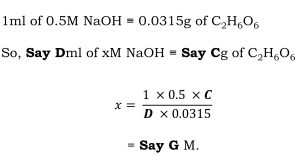
Concentration of drug in organic layer

Concentration of drug in aqueous layer

Partition coefficient of drug

Result
The partition coefficient of given unknown drug was found to be _____
Line page content
Aim
Determination of partition coefficient of unknown drug
Reference
A practical handbook of medicinal chemistry, Nirali prakshan, page No 76-77
Requirement
Apparatus
Iodine flask, Burette, conical flask, measuring cylinder, separating funnel
Chemical
Benzene, distilled water, sodium hydroxide, oxalic acid, phenopthalein, drug
Instrument
Weighing balance, shaker, sonicator
Theory
Diffusion of drug from the point of application to desired target site depends on drug’s lipid solubility. Ionized drug are more water soluble and hence there diffusion will be less. The rate of diffusion of neutral molecules depends on lipid solubility and the concentration gradient across the membrane. From this it can be conclude that more is lipid soluble and concentration gradient across the membrane more will be diffusion of drug.
Partition coefficient or distribution coefficient is defined as the ratio of concentration of compound in a mixture of two immiscible phases at equilibrium and is represented as

Higher is the value of partition coefficient higher greater will be the rate of diffusion of drug.
n-octanol is most favor organic solvent during the determination of partition coefficient of medicinal agents due to following reasons
- n-octanol has low vapour pressure at room temperature
- It is transparent to UV region which makes the analytical identification of drug easy
- It has a long saturated fatty alkyl chain
- It has one hydroxyl group that form hydrogen bonds with drug molecule
- Hydroxyl group dissolves water to such an extent that water saturated octanol contains 1.7M water.
All these properties of n-octanol make it very close to those of natural membranes and macromolecules.
Precautions while performing assay
- Air bubble from the burette should be removed. If air bubble is kept then there will be incorrect estimation of aspirin content.
- Addition of sodium hydroxide from burette should be slow with continuous stirring. Faster addition or slow addition without stirring will provide pre-mature end point causing error while determining the concentration of drug.
- The 0.5M sodium hydroxide solution should be freshly prepared. While preparing the solution the distilled water should be freshly boiled and cooled. If the distilled water is not boiled or solution is not freshly prepared then molarity of sodium hydroxide will decrease due to reaction with bicarbonic acid. The latter acid is formed due to absorption of atmospheric carbon dioxide in water.
- Shaking speed will alter the rate of diffusion in two immiscible liquid. Thus efficient shaking is required.
Preparation of reagent
0.5M Sodium hydroxide solution
Weigh 2g of sodium hydroxide and dissolved in approximately 50ml of carbon dioxide free water and dissolve the content. After complete dissolution of sodium hydroxide the volume was made up to 100ml with carbon dioxide free distilled water and volumetric flask is corked to prevent entry of carbon dioxide.
Procedure
- Clean all the apparatus required for the titration.
- ____g of sodium hydroxide was weighed and was dissolved in 50ml of carbon dioxide free distilled water. After complete dissolution the volume of the solution was made up to 100ml with carbon dioxide free distilled water.
- ___g of oxalic acid was weighed and was transferred to 100ml volumetric flask. To it 50ml of distilled water was added and after the dissolution of solid, volume was made up to 100ml with distilled water.
- Fill the burette with the prepared sodium hydroxide solution and air bubble was removed and the volume was adjusted to mark.
- 10ml of oxalic acid solution was taken into a conical flask to it add 2 drops of phenolphthalein indicator and was titrated with sodium hydroxide solution until light pink colour was obtained.
- The burette reading was noted and step was repeated for two more reading. All the readings were tabulated in the table and the molarity of sodium hydroxide solution was calculated.
- In iodine flask, _____ml (50ml) of benzene was taken.
- To it add ____g (1g) of drug and was shaken vigorously.
- To this iodine flask, ___ml (50ml) of distilled water was added
- The iodine flask was stoppered and was vigorously shaken for 30 minutes.
- After 30 minutes, the content of iodine flask was transfer to separating funnel and kept it aside for 10 minutes.
- The aqueous layer and organic layer were collected in separate beaker. Discard the intermediate layer.
- Pipette out ___ (10ml) from the organic layer, add 1 drop of phenolphthalein and titrate with sodium hydroxide solution.
- Repeat the step 13 for another reading and take the average of both reading.
- Repeat step 13 and 14 for aqueous layer
- Now determined the concentration of drug in individual layer by using suitable method.
- Put the concentrations of drug obtain in partition coefficient formula and determined the partition coefficient value of drug in benzene-water system.
Result
The partition coefficient of given unknown drug was found to be _____
Practical No 19: Conventional Benzocaine synthesis
Blank page content
Aim
Conventional synthesis of Benzocaine
Observation
- Weight of watch glass + p-amino benzoic acid :_________ g
- Weight of watch after transfer :_________ g
- Weight of p-amino benzoic acid taken for synthesis :_________ g (Say A)
- Molecular weight of p-amino benzoic acid :_________ g
- Molecular weight of benzocaine :_________ g
- Weight of container :_________ g
- Weight of Container + benzocaine :_________ g
- Weight of synthesized benzocaine :_________ g
Reaction

Reaction Mechanism

Calculation

Result

Line page content
Aim
Conventional synthesis of Benzocaine
Reference
- Furniss B. S., Hannaford A.J., Smith P.W.G., Tatchell A.R., Vogel’s Textbook of Practical Organic Chemistry, Fifth Ed, Longman Sci and Technical, 1989, page 897.
Requirement
Apparatus
RBF, Condensor, HCl gas generation assembly, Beaker, Waterbath
Chemical
4-aminobenzoic acid, ethanol, concentrated sulphuric acid, concentrated hydrochloric acid, crude sodium chloride, sodium carbonate
Instrument
Weighing balance, hot air oven, suction assembly
Theory
Benzocaine is a local anaesthetic that belongs to the class of ester-type anaesthetics. It is chemically known as ethyl p-aminobenzoate. Benzocaine can be synthesized by the esterification of 4-aminobenzoic acid (PABA) with ethanol in the presence of a strong acid catalyst such as concentrated hydrochloric acid.
In this reaction, the carboxylic acid group (–COOH) of 4-aminobenzoic acid reacts with the hydroxyl group (–OH) of ethanol to form an ester (–COO–) linkage, producing benzocaine and water as a by-product. The reaction is typically carried out under reflux conditions to increase the reaction rate and ensure complete conversion of the reactants.
After completion of the reaction, the product is usually neutralized, precipitated, and purified by recrystallization, often using ethanol or another suitable solvent. The purified benzocaine appears as white crystalline solid.
Principle
The synthesis of benzocaine is based on the Fischer esterification reaction, which involves the acid-catalyzed reaction between a carboxylic acid and an alcohol to form an ester and water.
Procedure
- Place _____ ml (80ml) of absolute ethanol in a 250 m1 two-necked flask equipped with a double surface reflux condenser and a gas inlet tube.
- Pass dry hydrogen chloride through the alcohol until saturated – the increase in weight is about 20g
- Remove the gas inlet tube,
- Introduce _____ g (12g; 0.088mol) of paminobenzoic acid and heat the mixture under reflux for 2 hours.
- Upon cooling, the reaction mixture sets to a solid mass of the hydrochloride of ethyl p-aminobenzoate.
- Pour this hot solution into ______ ml (300ml) of water.
- Add solid sodium carbonate carefully to the clear solution until it is neutral to litmus.
- Filter off the precipitated ester at the pump and dry in the air.
- The yield of ethyl p-aminobenzoate, m.p. 91°C, is 10 g (69%).
- Determine the product yield, % yield, melting point and TLC and report the date in the table.
Result
Practical No 20: Microwave assist synthesis of 1H-Benzimidazole
Conventional synthesis of Benzocaine
Blank page content
Aim
Microwave synthesis of 1H-Benzimidazole
Observation
Observations
- Weight of watch glass + o-phenylene diamine :_________ g
- Weight of watch glass after transfer :_________ g
- Weight of o-phenylene diamine taken for synthesis :_________ g (Say A)
- Molecular weight of o-phenylene diamine :_________ g
- Molecular weight of Benzimidazole :_________ g
- Weight of container :_________ g
- Weight of Container + Benzimidazole :_________ g
- Weight of synthesized Benzimidazole :_________ g
Reaction
Reaction Mechanism
Calculation
Result
Line page content
Aim
Microwave synthesis of 1H-Benzimidazole
Reference
D. Shah, M. Patel, D. Patel, A. Patel. Current Green Chemistry, Volume 12 (2), 2025, 159-165.
Requirement
Apparatus
Conical Flask, Funnel, Beaker, Measuring cylinder
Chemical
Formic acid, o-phenylenediamine, Sodium hydroxide, water
Instrument
Microwave, Suction filtration assembly, IR Lamp, Weighing balance
Theory
The synthesis of benzimidazole is based on condensation reaction of diamine with formic acid. The amine functional groups act as a nucleophile. The electron of this nucleophile is shared with carbocation present in formic acid. This sharing of electrons leads to cyclization and formation of Benzimidazole. The reaction is catalyzed by sodium hydroxide solution.
Procedure
- In a clean concial flask, take ____g (0.54) of o-phenylene diamine and to it add ____g (0.18g) of 90% formic acid solution.
- Put the funnel on the concial flask.
- Transfer this assemble to microwave.
- Keep the beaker fill with water for creating sink condition
- Set the radiation intenstity to 30%.
- Set the time for 6 minutes.
- Start the microwave and check the rection after every 30 seconds upto 6 minutes.
- After 6 minutes, cool the mixture.
- After through cooling, add 10% sodium hydroxide solution till the solution is alkaline to litmus.
- Filter the crude benzimidazole at pump and wash it with ice-cold mixture.
- Recrystallization was done by hot water with decolourizing carbon
- Determine the product yield, % yield, melting point and TLC and report the date in the table.
Application of synthesis
Benzimidazole is used for the synthesis of various drugs belong to
- Antihistaminic (Astemiazole)
- Analgesics (Benzitramide)
- Anti-hypertensive (Candesartan)
- Anti-allergic (Emedastine)
- Anti-ulcer (Lansoprazole)
- Antiviral (Maribavir)
- Anthelmintics (Albendazole) etc
Result