BP305P – Organic Chemistry-II Lab Manual Practical No 4
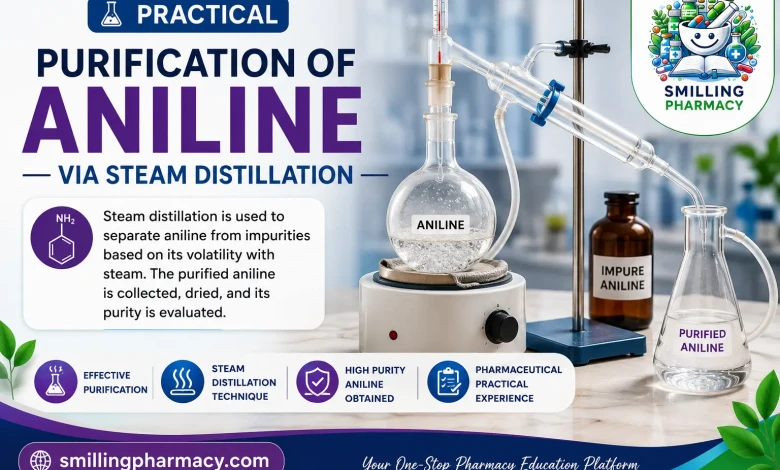
Purification of Aniline via steam distillation
Paid Advertisements
Table of Contents
Presentation of this practical
Podcast of this practical
In Hindi
In Marathi
Practical No 4
Line page content
Aim
To purify impure aniline by steam distillation and determine the percentage yield
Learning Objectives
Upon completion of this experiment, I will be able to:
- Explain the principle of steam distillation.
- Identify organic compounds suitable for purification by steam distillation.
- Assemble and operate a steam distillation apparatus safely.
- Purify aniline by steam distillation.
- Separate aniline from the distillate and calculate the percentage yield.
- Evaluate the purity of aniline by observing its physical properties.
Learning Outcomes
After successful completion of this practical, I will be able to:
- Explain the principle and applications of steam distillation.
- Assemble and operate a steam distillation apparatus correctly.
- Purify aniline using steam distillation.
- Separate and dry the purified organic liquid.
- Calculate the percentage yield of purified aniline.
- Apply appropriate laboratory safety measures while handling volatile organic compounds.
Reference
Vogel’s Textbook of Practical Organic Chemistry. Longman Scientific & Technical, 1989.
Requirements
Apparatus
Round-bottom flask (250 mL), Steam distillation apparatus, Steam generator (or water flask), Condenser, Receiver (conical flask), Separating funnel, Thermometer, Rubber tubing, Retort stand and clamps, Measuring cylinder.
Chemicals
Impure aniline, Distilled water, anhydrous sodium sulfate (drying agent)
Instruments
Heating mantle or hot plate, Analytical balance
Principle
Steam distillation is a separation and purification technique used for organic compounds that are immiscible or only slightly miscible with water, possess high boiling points, and are volatile in steam. In steam distillation, the mixture of water and the organic compound boils when the combined vapour pressures of both components equal atmospheric pressure. Consequently, the organic compound distils at a temperature lower than its normal boiling point, preventing thermal decomposition.
Aniline (C₆H₅NH₂) has a normal boiling point of approximately 184°C. Since it is only slightly soluble in water and is volatile with steam, it can be purified by steam distillation. During the process, steam carries aniline vapours into the condenser, where they condense into a mixture of water and aniline. The aniline is then separated from the aqueous layer using a separating funnel.
Theory
Steam distillation is based on Dalton’s law of partial pressures. When two immiscible liquids are heated together, each exerts its own vapour pressure independently.
Aniline (C₆H₅NH₂) is a colourless to pale yellow aromatic amine with a characteristic odour. Commercial or laboratory samples often contain coloured impurities formed by oxidation during storage. Steam distillation effectively separates aniline from these non-volatile impurities because aniline readily vaporizes with steam while most impurities remain in the distillation flask.
The distillate contains two immiscible liquid layers: water and aniline. After separation and drying, purified aniline is obtained. Steam distillation is commonly used for purifying essential oils, aromatic amines, nitro compounds, and phenolic compounds.
Procedure
Step 1: Preparation of Apparatus
- Assemble the steam distillation apparatus securely.
- Connect the steam generator to the distillation flask containing impure aniline.
- Attach the condenser and receiving flask.
- Ensure that all joints are leak-proof.
Step 2: Addition of Sample
- Transfer 20 mL of impure aniline into the round-bottom flask.
- Add approximately 100 mL of distilled water.
Step 3: Steam Distillation
- Heat the steam generator until steam is produced.
- Pass steam into the flask containing aniline.
- Continue heating gently.
- The mixture of steam and aniline vapours passes through the condenser.
- Collect the distillate until no more oily droplets appear in the receiver.
Step 4: Separation
- Transfer the distillate into a separating funnel.
- Allow the aqueous and organic layers to separate completely.
- Collect the lower aniline layer (or upper layer, depending on the temperature and composition; identify the layers before separation).
- Discard the aqueous layer appropriately.
Step 5: Drying
- Add a small quantity of anhydrous sodium sulfate to the collected aniline.
- Swirl gently and allow the mixture to stand for about 10–15 minutes.
- Decant or filter the dried aniline into a clean, dry container.
Step 6: Measurement
Measure the volume (or weight) of the purified aniline obtained.
Precautions
- Assemble the apparatus carefully and ensure all joints are airtight.
- Heat the steam generator gradually to produce a steady flow of steam.
- Do not allow the distillation flask to become dry during the experiment.
- Maintain continuous cooling water through the condenser.
- Do not overheat the apparatus.
- Identify the organic and aqueous layers correctly before separation.
- Use anhydrous sodium sulfate only until the drying agent remains free-flowing.
- Handle aniline in a fume hood or well-ventilated laboratory, as it is toxic and can be absorbed through the skin.
- Wear gloves, laboratory coat, and safety goggles throughout the experiment.
Sources of Error
- Leakage of steam from the apparatus.
- Incomplete condensation due to insufficient cooling.
- Incomplete separation of aqueous and organic layers.
- Mechanical loss of aniline during transfer.
- Inadequate drying of the organic layer.
- Excessive heating causing bumping or sample loss.
Result
The impure aniline was successfully purified by steam distillation with % yield of ________ and have the boiling point of _______ °C
Blank page content
Aim
To purify impure aniline by steam distillation and determine the percentage yield.
Observations
- Weight of Weighing Bottle + Crude Aniline: ________ g
- Weight of Weighing Bottle after transfer: ________ g
- Weight of Aniline taken for estimation (1-2): ________ g
- Weight of weighing bottle + pure aniline: ________ g
- Weight of weighing bottle after transfer: ________ g
- Weight of pure aniline obtained (4-5): ________ g
Boiling Point of aniline: ________ °C
Calculations
Result
The impure aniline was successfully purified by steam distillation with % yield of ________ and have the boiling point of _______ °C