BP305PPharma GuidePractical No 6

BP305P – Organic Chemistry-II Lab Manual Practical No 6 [Saponification Value]
Our Other Brands

Youtube channel

Telegram channel

Paid Advertisements

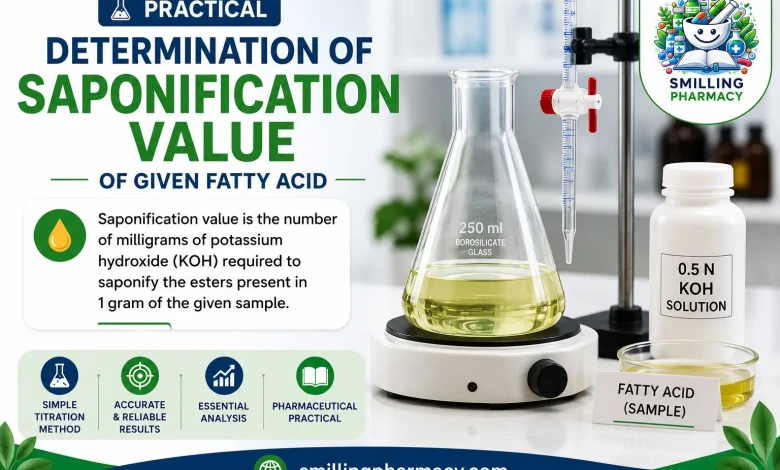
ChatGPT Image Jul 8, 2026, 12_16_29 AM

Table of Contents

Practical No 6

Line page content

Aim

Determination of Saponification Value of given fats and oils

Learning Objectives

After performing this experiment, I should be able to:
  1. Understand the concept and significance of the saponification value of fats and oils.
  2. Explain the principle of alkaline hydrolysis (saponification) of fats and oils.
  3. Perform refluxing of a fat or oil sample with alcoholic potassium hydroxide.
  4. Determine the excess potassium hydroxide by back titration with standard hydrochloric acid.
  5. Calculate the saponification value and express it in mg of KOH per gram of sample.
  6. Understand the application of saponification value in the identification and quality assessment of fats and oils.

Learning Outcomes

At the end of this practical, I will be able to:

  • Define saponification value and state its unit.
  • Describe the chemical reaction involved in saponification.
  • Carry out the experimental procedure using appropriate laboratory apparatus.
  • Record observations and calculate the saponification value accurately.
  • Interpret the results and explain the relationship between fatty acid chain length and saponification value.
  • Identify potential experimental errors and follow appropriate laboratory safety precautions.

Reference

  1. Agrawal, O. P. Advanced Practical Organic Chemistry. Publisher: Krishna Prakashan Media Pvt Ltd. Page 275 
  1. Food Safety and Standards Authority of India (FSSAI). Manual of Methods of Analysis of Foods: Oils and Fats. 2016 edition, Section 9, page no. 18–19.

Requirements

Apparatus

250 mL Round-bottom flask, Reflux condenser, Burette, Pipette, Measuring cylinder, Volumetric flask, Beakers, Funnel, Glass rod, Clamp and stand, water bath

Chemicals

Given fat or oil sample, Alcoholic potassium  hydroxide (KOH), Standard hydrochloric acid (HCl), Phenolphthalein indicator, Ethanol

Instruments

Analytical balance

Theory

Fats and oils are mainly composed of triglycerides, which are esters formed from glycerol and three fatty acid molecules. When these esters are heated with an excess of alcoholic potassium hydroxide, they undergo alkaline hydrolysis, producing glycerol and potassium salts of fatty acids, which are commonly called soaps.

001-01

The saponification value is the number of milligrams of potassium hydroxide required to neutralize the free fatty acids and saponify the esters present in 1 gram of a fat or oil.

Saponification value is useful for:

  1. Characterizing fats and oils.
  2. Comparing the average molecular weight of fatty acids in different samples.
  3. Assessing the quality and identity of fats and oils.
  4. Detecting possible adulteration when the measured value differs substantially from the expected value.

In general, fats and oils containing shorter-chain fatty acids have a higher saponification value because more fatty acid groups are present per unit mass. Those containing longer-chain fatty acids tend to have a lower value.

Principle

A known weight of the fat or oil is refluxed with a measured excess of alcoholic potassium hydroxide. The KOH reacts with the fatty acids and ester groups present in the sample.

After saponification is complete, the unreacted KOH is titrated against standard hydrochloric acid using phenolphthalein as an indicator. A blank titration is performed under identical conditions without the fat or oil sample.

The difference between the blank titre and sample titre represents the amount of KOH consumed by the sample. This difference is used to calculate the saponification value.

Procedure

Step 1: Preparation
  1. Clean and dry all the required glassware.
  2. Weigh accurately about 2.0 g of the given fat or oil into a clean, dry round-bottom.
  3. Pipette 50 mL of alcoholic KOH solution into the flask.
Step II: Saponification

4. Attach a reflux condenser securely to the flask.

5. Heat the mixture gently using a water bath under reflux for 30 minutes,

6. Shake the flask occassionaly while refluxing

Step III: Titration of the sample

7. Allow the flask to cool at room temperature. 
8. Add 1-2drops  of phenolphthalein indicator.
9. Titrate the excess KOH with standard HCl while mixing the contents. 
10. Record the volume of HCl consumed by the sample.

Step IV: Blank determination

11. In the another RBF, add 50ml of alcoholic KOH.
12. Reflux it for 30 minutes with ocassional saking
13. Cool the flask to room temperature
14. Add 1-2 drops of phenolphthalein indicator
15. Titrate with standard HCl solution.
16. Record the volume of HCl consumed by the blank.

Step V: Determination of Saponification value

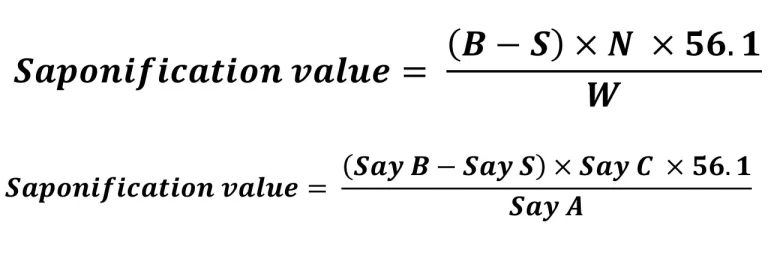
Calculate the saponification value using the formula –

New Microsoft PowerPoint Presentation

Where,  
B is the blank reading
S is the sample reading
(B – S) is indicated as the difference between the volume (in mL) of HCl solution used for the blank run and for the tested sample; 
N is defined as the normality of HCl solution, in mol·L−1; 
56.1 is indicated as the molecular weight of KOH , in g·mol−1; and 
W is indicated as the weight of sample, in g.

Precautions while performing the practical
  1. Use clean, dry glassware to avoid contamination and interference from moisture.
  2. Weigh the fat or oil accurately using an analytical balance.
  3. Use the prescribed volume and concentration of alcoholic KOH.
  4. Ensure that the reflux condenser is properly fitted before heating.
  5. Heat gently and uniformly; do not heat an alcoholic solution over an open flame because alcohol is flammable.
  6. Prevent the loss of alcohol vapour by maintaining proper reflux.
  7. Ensure complete saponification before titration.
  8. Perform the blank determination under exactly the same conditions as the sample.
  9. Add phenolphthalein in the prescribed quantity and observe the endpoint carefully.
  10. Use the same standardized HCl solution for the sample and blank.
  11. Record the initial and final burette readings accurately.
  12. Wear a laboratory coat, protective gloves and safety goggles while handling KOH and HCl, as both are corrosive.
Sources of error in this practical
  1. Incomplete saponification
  2. Inaccurate weighing
  3. Incorrect reagent concentration
  4. Loss of alcohol 
  5. Moisture in the sample
  6. Incorrect endpoint detection
  7. Improper blank determination
  8. Burette reading errors
  9. Impurities in the sample:
  10. Absorption of carbon dioxide by KOH

Result

The saponification value of the given sample of fat/oil was found to be ______ 

Blank page content

Aim

Determination of Saponification Value of given fats and oils

Observations

  1. Weight of weighing bottle + fat/Oil: ____ g
  2. Weight of weighing bottle after transfer: ___ g
  3. Weight of fat/oil taken: ____ g (Say A)
  4. Molarity of prepared KOH: ____ M
  5. Molarity of prepared HCl: ____ M (Say C)

Observations table

Sr. No.

Content in flask

Burette reading “mL”

1

Sample Reading

Say S

2

Blank Reading

Say B

Calculations

New Microsoft PowerPoint Presentation

Result

The saponification value of the given sample of fat/oil was found to be ______ 

Back to top button
error: Content is protected !!

Adblock Detected

We are providing important content to you for free of cost. We in return expect you to please turn off the adblocker in your browser and refresh the page to see the content. Thank you.