BP305P – Organic Chemistry-II Lab Manual Practical No 7 [Ester Value]

Paid Advertisements
Table of Contents
Practical No 7
Line page content
Aim
To determine the ester value of given fats/oils
Learning Objectives
After performing this practical, I will able to:
- Define ester value and explain its significance in the analysis of fats and oils.
- Understand the relationship between ester value, saponification value, and acid value.
- Explain the principle of alkaline hydrolysis (saponification) of esters.
- Handle burettes, pipettes, analytical balances, and reflux apparatus correctly.
- Perform a titrimetric determination using standardized reagents.
- Calculate the ester value and express the result in mg of KOH per gram of sample.
- Identify common experimental errors that affect the accuracy of the result.
Learning Outcomes
At the end of this practical, I will be able to:
- Determine the ester value of a given fat or oil using an appropriate titrimetric method.
- Distinguish between acid value, saponification value, and ester value.
- Record observations and calculate the result using the correct formula.
- Interpret the ester value as an analytical characteristic of a fat or oil.
- Follow laboratory safety measures while handling alcoholic potassium hydroxide and hydrochloric acid.
Reference
Indian Pharmacopeia, 2010, Indian Pharmacopoeia Co~mlsslon Ministry ofHealth &Family Welfare Government of India, published by The Indian Pharmacopoeia Commision, Gaziabad, page No 83-84, 95.
Requirements
Apparatus
RBF, Reflux condenser, Burette (50 mL), Pipettes (10 mL and 25 mL), Measuring cylinder (25 mL or 50 mL), Beakers and glass funnel, Glass rod, Wash bottle, water bath, Retort stand and clamps
Chemicals
Fat/oil sample, alcoholic KOH, 0.5N HCl, neutralized ethanol, Phenolphthalein indicator
Instruments
Analytical balance for accurate weighing
Theory
The ester value indicates the ester content in fats or oils. Ester value is used to assess the purity and quality of fixed oils by estimating their ester (triglyceride) content. Olive oil used as a pharmaceutical vehicle is tested for its ester value. A high ester value indicates that most fatty acids are present as triglycerides (good quality), whereas a low ester value may indicate hydrolysis or deterioration due to the formation of free fatty acids.
Definition
Ester Value is the number of milligrams (mg) of potassium hydroxide (KOH) required to saponify the esters present in 1 gram of fat or oil. It indicates the amount of esterified fatty acids (triglycerides) in fats and oils.
Significance
- Indicates the amount of esterified fatty acids in fats and oils.
- Helps assess the quality and purity of fats and oils.
- Used to detect hydrolysis or rancidity.
- Useful in the food, pharmaceutical, and cosmetic industries for quality control.
- Assists in identifying adulteration when used with other constants such as Acid Value, Saponification Value, and Iodine Value.
Principle
Fats and oils contain triglycerides (esters). During saponification, the esters react with an excess of alcoholic KOH to form glycerol and potassium salts of fatty acids (soap). The amount of KOH consumed in saponifying the esters is determined indirectly. The Ester Value is calculated by subtracting the Acid Value (AV) from the Saponification Value (SV).
Ester Value (EV)=Saponification Value (SV)−Acid Value (AV)
Procedure
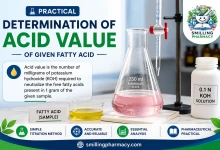
Step I: Determination of Acid value
Describe in practical No 5, page No _____
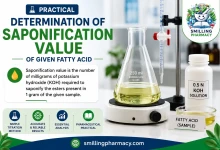
Step 2: Determination of Saponification value
Describe in practical No 6, page No _____
Dettermination of ester value
The Ester Value is calculated by subtracting the Acid Value (AV) from the Saponification Value (SV).
Ester Value (EV)=Saponification Value (SV)−Acid Value (AV)
Result
The ester value of given fat/oil was found to be ________
Blank page content
Aim
To determine the ester value of given fats/oils
Observations
- Weight of weighing bottle + fat/ oil: _____ g
- Weight of weighing bottle after transfer: _____ g
- Weight of fat/oil taken (1-2): _____ g (Say A)
- Normality of alcoholic KOH: _____ N
- Normality of HCl prepared: _____ N (Say C)
Observations table
|
Sr. No. |
Content in flask |
Burette reading “mL” |
|
1 |
Acid Value determination |
Say D |
|
2 |
Saponification value determination |
|
|
A |
Sample Reading |
Say S |
|
B |
Blank Reading |
Say B |
Calculations
Step I: Determination of Acid value
Step 2: Determination of Saponification value
Dettermination of ester value
Ester Value (EV)=Saponification Value (SV)−Acid Value (AV)
Ester value = Say E – Say F
Ester value = _______
Result
The ester value of given fat/oil was found to be ________