

BP305P – Organic Chemistry-II Lab Manual Practical No 5 [Acid Value ]
Our Other Brands
Youtube channel

Telegram channel

Paid Advertisements

Table of Contents
Practical No 5
Line page content
Aim
To determine the Acid Value of given fatty acid
Learning Objectives
Upon completion of this experiment, I will be able to:
- Define acid value and explain its pharmaceutical significance.
- Explain the principle involved in the determination of acid value.
- Prepare and standardize 0.1 N ethanolic potassium hydroxide solution.
- Perform the acid value determination using the titrimetric method.
- Calculate the acid value of the given fatty oil/fat.
- Interpret the quality of fats and oils based on the acid value.
- Identify possible sources of experimental error and adopt suitable precautions during the analysis.
Learning Outcomes
After successful completion of this practical, I will be able to:
- Explain the concept and importance of acid value in quality control of fats and oils.
- Prepare and accurately standardize ethanolic potassium hydroxide solution.
- Determine the acid value of an unknown fatty oil/fat using volumetric analysis.
- Perform calculations involved in acid value determination.
- Assess the freshness and degree of hydrolytic rancidity of fats and oils.
- Follow Good Laboratory Practices (GLP) while performing analytical experiments.
Reference
Indian Pharmacopoeia Commission. Indian Pharmacopoeia. Ghaziabad, India.
Requirements
Apparatus
Conical flask (250 mL), Burette (50 mL), Pipette (10 mL), Measuring cylinder (50 mL), Beaker (100 mL), Funnel, Glass rod, Wash bottle
Chemicals
Fatty acid sample, 0.1 N Potassium hydroxide (KOH) in ethanol, Neutralized ethyl alcohol (95%), Phenolphthalein indicator (1% alcoholic solution), Distilled water
Instruments
Electronic analytical balance, Magnetic stirrer
Principle
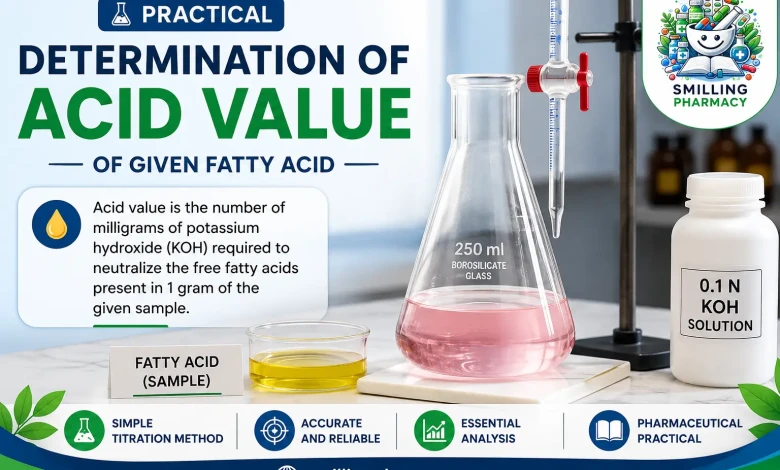
The acid value is defined as the number of milligrams of potassium hydroxide (KOH) required to neutralize the free fatty acids present in 1 g of fat or oil. The acid value of fats and oils are calculated by using the formula –

Natural fats and oils mainly consist of triglycerides. During storage or improper handling, triglycerides undergo hydrolysis in the presence of moisture, enzymes, heat, or microorganisms, releasing free fatty acids (FFA). The amount of these free fatty acids increases as the oil deteriorates.
The free fatty acids present in the sample are neutralized by a standard solution of ethanolic potassium hydroxide using phenolphthalein as the indicator. The end point is indicated by the appearance of a permanent pale pink colour that persists for at least 15 seconds.
The acid value is directly proportional to the concentration of free fatty acids present in the sample. A lower acid value indicates better quality and freshness of the oil, whereas a higher acid value indicates hydrolytic rancidity and deterioration.
Chemical Reaction
For a free fatty acid represented as RCOOH:
RCOOH + KOH → RCOOK + H₂O
The free fatty acid reacts quantitatively with potassium hydroxide to form potassium soap and water.
Chemical used and its purpose
Ethanolic Potassium Hydroxide (0.1 N):
Acts as the titrant to neutralize the free fatty acids present in the oil. Most fats and oils are insoluble in water but readily dissolve in ethanol. Preparing potassium hydroxide in ethanol provides a homogeneous reaction medium, ensuring complete neutralization of free fatty acids and accurate titration.
2. Neutralized Ethanol (95%)
Serves as the solvent for dissolving the oil sample. Dissolves fats and oils effectively, Mixes well with ethanolic KOH, and Produces a single reaction phase, Facilitates accurate endpoint detection, the ethanol is neutralized before use to eliminate any acidic or alkaline impurities that could interfere with the titration.
3. Phenolphthalein Indicator
Indicates the completion of the neutralization reaction. Phenolphthalein is colourless in acidic medium and turns pale pink in slightly alkaline medium (pH 8.2–10.0). It provides a sharp and easily observable endpoint for acid-base titrations involving weak acids and strong bases.
4. Potassium Hydrogen Phthalate (KHP)
Primary standard used for standardizing ethanolic potassium hydroxide. KHP is selected because it:
- is available in high purity,
- is chemically stable,
- is non-hygroscopic,
- has a high molecular weight,
- can be accurately weighed,
- Reacts quantitatively with KOH.
Theory
Fats and oils contain triglycerides which, on hydrolysis, produce glycerol and fatty acids. Free fatty acids may be naturally present due to hydrolysis during storage, processing, or oxidation. The amount of free fatty acids present in a fatty substance is an important quality parameter.
The acid value is defined as the number of milligrams of potassium hydroxide (KOH) required to neutralize the free fatty acids present in one gram of fat or fatty acid sample.
The acid value is widely used in food industries, pharmaceutical industries, edible oil industries, soap manufacturing, cosmetics, and biodiesel production to determine the extent of hydrolysis or deterioration of fats and oils.
A low acid value indicates good quality and freshness, whereas a high acid value indicates decomposition or hydrolytic rancidity.
Factors Affecting Acid Value
The acid value of oils and fats increases due to:
- Presence of moisture
- Exposure to air
- High storage temperature
- Lipase enzyme activity
- Microbial contamination
- Long storage period
- Improper handling
- Repeated heating during cooking
Procedure
Preparation of 0.1M alcoholic KOH
In a Clean dry 100 mL volumetric flask, add accurately weigh (0.561 g) of potassium hydroxide using funnel. To it add approximately 45ml of neutralized ethanol. Shake the content vigorously till all added potassium hydroxide has dissolved. After dissolution, make the volume up to mark with neutralized ethanol. Transfer the content to stopper flask, and label it as 0.1N ethanolic KOH.
Step 1: Weighing of sample fatty acid
- Clean and dry all glassware.
- Weigh accurately about 1g of the given fatty acid sample in a clean, dry 250 mL conical flask.
Step 2: Dissolution
3. Add 5 mL neutralized ethyl alcohol into the flask.
4. Warm gently, if necessary, until the sample dissolves completely.
5.Allow the solution to cool to room temperature.
Step 3: Addition of Indicator
Add 2–3 drops of phenolphthalein indicator.
Step 4: Titration
- Fill the burette with 0.1 N alcoholic KOH solution.
- Record the initial burette reading.
- Titrate the solution while continuously swirling.
- Continue titration until a faint permanent pink colour persists for 30 seconds.
- Record the final burette reading.
- Repeat the titration until concordant readings are obtained.
Step 5: Determination of acid value
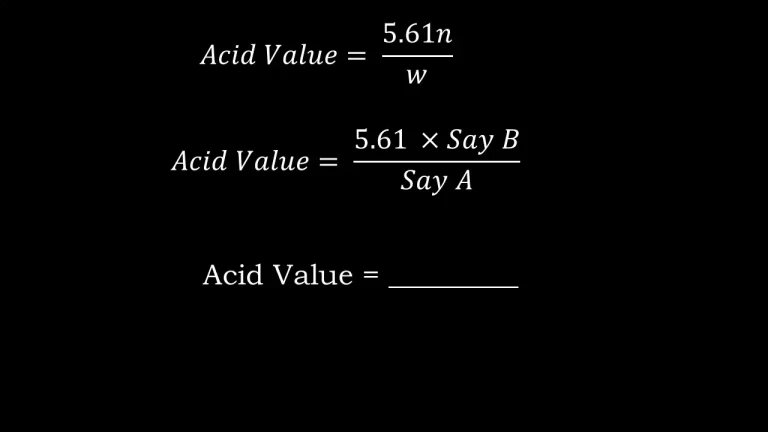
The acid value for given fatty acid is calculated by using formula –
Where, n is the number of ml of 0.1N KOH solution required, w is the weight in g, of the fatty acid taken.
Precautions
- Use freshly prepared and standardized alcoholic KOH solution.
- Neutralize the alcohol before use.
- Weigh the sample accurately using an analytical balance.
- Ensure complete dissolution of the sample before titration.
- Avoid overheating during dissolution.
- Add only 2–3 drops of phenolphthalein indicator.
- Observe the endpoint carefully; the pink colour should persist for about 30 seconds.
- Perform at least three concordant titrations.
- Clean and rinse the burette with KOH solution before filling.
- Record burette readings at eye level to avoid parallax error.
Sources of Error
- Incomplete dissolution of the fatty acid in the ethanol–ether solvent mixture may lead to inaccurate titration results.
- Presence of moisture or carbon dioxide (CO₂) in ethanolic potassium hydroxide can reduce its strength and affect the endpoint.
- Improper standardization of KOH solution results in erroneous acid value calculations.
- Incorrect endpoint detection due to over-titration or under-titration with phenolphthalein indicator.
- Using contaminated or wet glassware may alter the concentration of the reagents.
- Inaccurate weighing of the fatty acid sample introduces significant errors in the calculated acid value.
- Loss of sample during transfer from weighing bottle to conical flask affects the result.
- Insufficient mixing during titration may delay the appearance of the endpoint.
- Use of impure or oxidized fatty acid can produce unreliable acid value results.
- Delay in titration after sample preparation may allow atmospheric moisture or CO₂ absorption, affecting the titration.
Result
The acid value for given fatty acid was found to be ______
Blank page content
Aim
To determine the Acid Value of given fatty acid
Observations
- Weight of Watch glass + KOH: _____ g
- Weight of watch glass after transfer: _____ g
- Weight of KOH taken (1-2): _____ g/100 mL
- Weight of weighing bottle + fatty acid: _____ g
- Weight of weighing bottle after transfer: _____ g
- Weight of fatty acid taken (4-5): _____ g (Say A)
Observation table
|
Sr. No. |
Content in flask |
Burette reading “mL” |
Average burette reading “mL” |
|
1 |
Acid Value reading |
|
Say B |
|
2 |
|
||
|
3 |
|
Calculations
Result
The acid value for given fatty acid was found to be ______