BP301-Organic Chemistry-II: Study Material for Unit-III – Fats and Oils
Paid Advertisements
Table of Contents
About the post
This comprehensive educational resource, prepared by Dr. Anand Mundada, provides a detailed scientific overview of lipids, fats, and oils within the context of pharmaceutical chemistry. The text outlines the chemical structures of these organic compounds, primarily as triglycerides, and differentiates between solid fats and liquid oils based on their saturated or unsaturated fatty acid content. It explains various industrial processes used to manipulate these substances, including hydrogenation, hydrolysis, and saponification, which are essential for creating drug delivery systems, ointments, and soaps. Furthermore, the material highlights the pharmaceutical challenges regarding stability, such as oxidation and rancidity, and how these affect the shelf life of medicines. A significant portion of the text is dedicated to analytical quality control, describing various constants like Acid, Iodine, and Saponification values used to verify purity. Ultimately, the source serves as a technical guide for pharmacy students to understand how lipids function as both biological reserves and critical raw materials in medicine manufacturing.
Presentation of this topic
Podcast of this topic
In Hindi
In Marathi
Paid Advertisements
Introduction to Lipids, Fats, and Oils with Pharmaceutical Correlation
Whenever we hear the word lipids, we usually think of fats and oils present in our food. However, in the pharmaceutical industry, lipids are much more than just nutrients. They are important raw materials used in the preparation of medicines, cosmetic products, ointments, creams, capsules, and advanced drug delivery systems.

-
Medicinal Chemistry-BasicsJuly 3, 2024
Lipids are a diverse group of organic compounds mainly composed of carbon, hydrogen, and oxygen. This group includes fats, oils, waxes, phospholipids, and steroids. They are hydrophobic, which means they do not dissolve in water but dissolve readily in non-polar organic solvents such as ether, chloroform, and benzene.
In the human body, lipids act as energy reserves, structural components of cell membranes, and precursors of hormones and other biologically important molecules. Similarly, in the pharmaceutical industry, lipids are used as drug carriers, emulsifying agents, ointment bases, and ingredients in soft gelatin capsules. Recently, lipid-based drug delivery systems, such as liposomes and lipid nanoparticles, have gained great importance because they improve the absorption and targeted delivery of drugs.
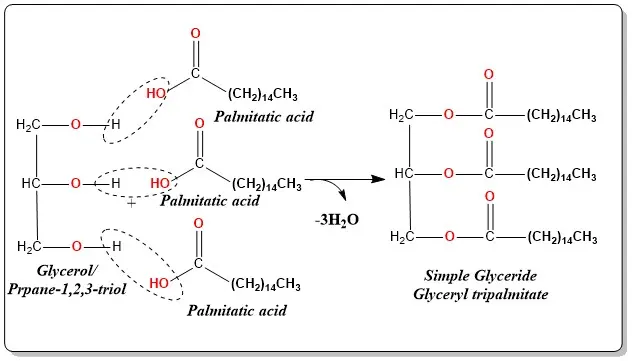
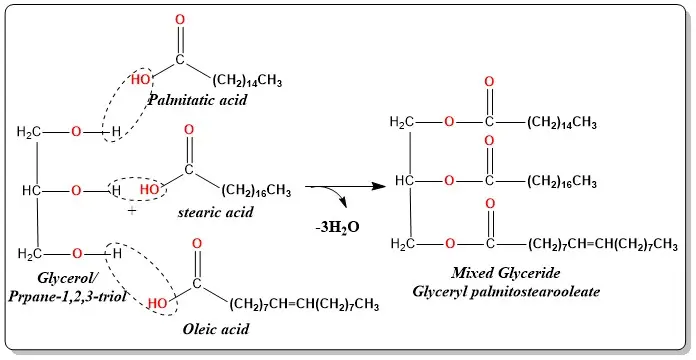
Among all lipids, fats and oils are the most commonly used. Chemically, they are esters of glycerol and higher fatty acids, also known as triglycerides or triacylglycerols. A triglyceride is formed when one molecule of glycerol combines with three molecules of fatty acids through a reaction called esterification.
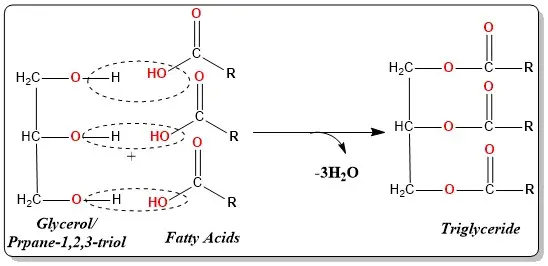
Depending on the fatty acids attached to glycerol, triglycerides are classified into simple glycerides and mixed glycerides.
If all three fatty acids are the same, the product is called a simple glyceride. For example, glycerol reacting with three molecules of palmitatic acid forms glyceryl tripalmitate, a simple glyceride.
If two or three different fatty acids are attached to glycerol, the product is called a mixed glyceride. Most natural fats and oils are mixed glycerides because they contain a variety of fatty acids.
Important Definitions
Fats
Fats are triglycerides that remain solid at room temperature (20–25°C). They generally contain a higher proportion of saturated fatty acids and are commonly used in pharmaceutical ointment and suppository bases.
Oils
Oils are triglycerides that remain liquid at room temperature (20–25°C). They usually contain a higher proportion of unsaturated fatty acids and are widely used as vehicles, emollients, and carriers in pharmaceutical formulations.
Triglycerides
Triglycerides are the triesters of glycerol with long-chain fatty acids (12–20 carbon atoms). They are the natural storage form of lipids and are widely used in pharmaceutical formulations because of their biocompatibility and ability to dissolve lipophilic drugs.
Natural Presence/Source of Fats and Oils
- Animal fat:
The major sources of animal fats are ghee; ghee-fat processed from milk, butter, milk, cheese, eggs, and fat from meat and fish. - Vegetable fat:
The main source of vegetable fat (vegetable oils) is plants. This is stored in the seeds. Some examples are mustard, corn, sunflower, cottonseed, olive, peanuts, and soyabean oils. - Others:
Cereals, pulses, nuts, and vegetables also contain small quantities of fat. For example, rice and wheat contain approximately 3% fat.
Extraction of fats/oils from natural source
Sr. No. | Fats | Oils |
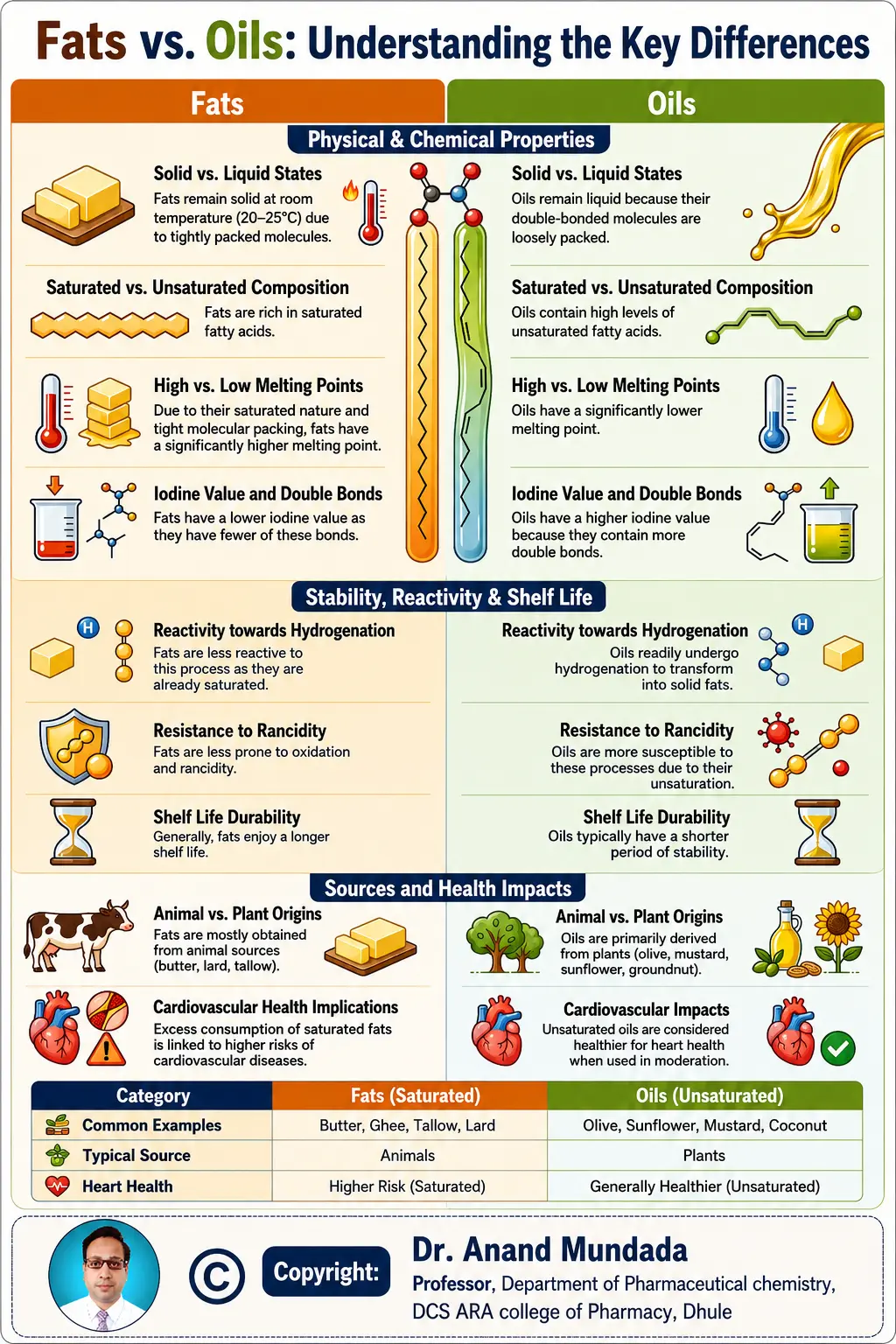
1 | Solid at room temperature (20–25°C) | Liquid at room temperature |
2 | Rich in saturated fatty acids | Rich in unsaturated fatty acids |
3 | Mostly obtained from animals sources such as butter, ghee, and lard. | Mostly obtained from plants sources such as sunflower, mustard, olive, and groundnut |
4 | Higher melting point | Lower melting point |
5 | Less reactive towards hydrogenation since they are already saturated. | Readily undergo hydrogenation to form solid fats. |
6 | Molecules are tightly packed because of saturated hydrocarbon chains | Molecules are loosely packed due to the presence of double bonds. |
7 | Less prone to oxidation and rancidity. | More prone to oxidation and rancidity because of unsaturation. |
8 | Generally have a longer shelf life. | Generally have a shorter shelf life. |
9 | Have a lower iodine value because they contain fewer double bonds. | Have a higher iodine value because they contain more double bonds |
10 | Examples: butter, ghee, tallow, lard. | Examples: olive oil, sunflower oil, mustard oil, coconut oil. |
11 | Excess consumption is generally associated with a higher risk of cardiovascular diseases due to higher saturated fat content. | Oils rich in unsaturated fatty acids are generally considered healthier for heart health when consumed in moderation. |
Essential fatty acids (EFA)
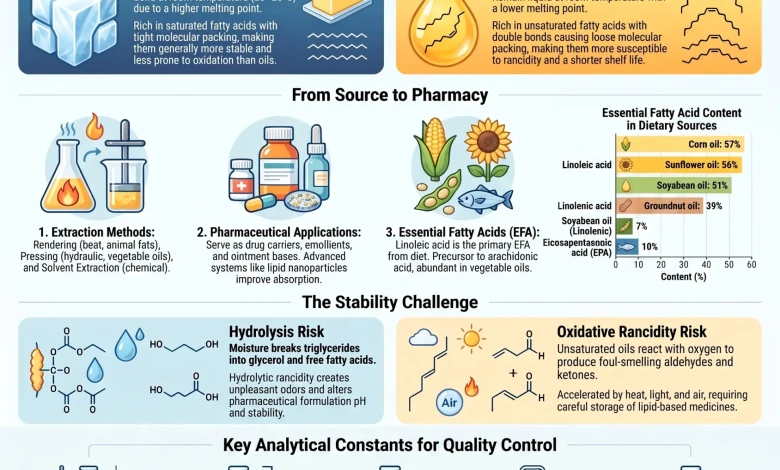
Essential fatty acids cannot be synthesized in our body. They can be derived only from food. The most important essential fatty acid (EFA) is Linoleic Acid, which serves as a basis for the production of other essential fatty acids (arachidonic acid). Vegetable oils are abundant in linoleic acid. It should be noted that not all polyunsaturated fatty acids are essential fatty acids. The dietary sources of essential fatty acid are enlisted in table as follows:
Essential Fatty Acid (EFA) | Dietary Source | Content (%) |
Linoleic acid | Corn oil | 57 |
Sunflower oil | 56 | |
Soyabean oil | 51 | |
Groundnut oil | 39 | |
Mustard oil | 15 | |
Coconut oil | 2 | |
Arachidonic acid | Milk (fat) | 0.4–0.6 |
Meat and eggs | 0.3–0.5 | |
Linolenic acid | Soyabean oil | 7 |
Green leafy vegetables | Variable | |
Eicosapentaenoic acid (EPA) | Fish oil | 10 |
Pharmaceutical Challenge
One of the biggest challenges in pharmaceutical manufacturing is that newest drug molecules are poorly soluble in water. Since lipids are hydrophobic, scientists use lipid-based formulations to improve the solubility and absorption of these drugs. However, lipids themselves present several challenges:
- Oxidation: Unsaturated oils can react with oxygen and become rancid, reducing the quality and shelf life of medicines.
- Hydrolysis: Moisture can break triglycerides into glycerol and free fatty acids, causing unpleasant odour and reducing product stability.
- Variation in natural sources: The composition of natural fats and oils varies with climate, season, and geographical location, making standardization difficult.
- Storage issues: Lipid-containing formulations require proper storage because heat, light, and air can cause degradation.
- Compatibility: Some drugs are incompatible with certain lipids, which can affect drug release and efficacy.
Therefore, pharmaceutical scientists carefully evaluate the quality of fats and oils by determining constants such as Acid Value, Saponification Value, Iodine Value, Ester Value, and Reichert-Meissl (RM) Value before using them in formulations.
Properties and Chemical Reactions of Fats and Oils
Imagine you are preparing food in your kitchen. You take out a bottle of sunflower oil or a packet of butter. Although both belong to the same family of compounds called lipids, one is a liquid while the other is a solid. Why does this happen? let us understand the physical and chemical properties of fats and oils.
Physical Properties of Fats and Oils
Fats and oils possess several characteristic physical properties that help us identify and use them in daily life.
1. Appearance and Feel
Fats and oils have a greasy or oily feel when touched. In their pure form, they are generally colourless, odourless, and tasteless. However, natural oils often appear yellow or golden because they contain natural pigments such as carotenoids and chlorophyll.
Example: Refined coconut oil is almost colourless, whereas mustard oil appears yellow due to natural pigments.
2. Solubility
One interesting property of fats and oils is that they do not mix with water. They are insoluble in water because both fats and oils are non-polar, whereas water is polar. However, they dissolve readily in organic solvents such as ether, chloroform, benzene, petroleum ether, and hot alcohol.
3. Specific Gravity
Fats and oils have a lower density than water. Therefore, when mixed with water, they float on its surface instead of sinking.
4. Emulsification
Although fats and oils do not dissolve in water, they can be dispersed into tiny droplets when shaken with water in the presence of an emulsifying agent such as soap, gelatin, gum acacia, or surfactants. This process is known as emulsification.
Chemical properties of fats and oils
1. Hydrolysis
Hydrolysis is one of the most important reactions of fats and oils. In this reaction, the ester bonds present in triglycerides are broken by the action of water. The reaction is usually accelerated by superheated steam. As a result, triglycerides break down into glycerol and free fatty acids. The breakdown of triglycerides is required for-
1. Production of Glycerol
The glycerol obtained is widely used in pharmaceutical formulations like Glycerin suppositories, Cough syrups, Moisturizing creams, Oral solutions etc. as
- Humectant
- Sweetening agent
- Solvent
- Plasticizer
- Suppository base
- Syrups
- Oral liquids
- Topical creams and ointment
2. Production of Free fatty acids
These fatty acids are used in manufacturing:
- Ointment bases
- Creams
- Emulsifiers
- Lubricants
- Tablet lubricants (e.g., magnesium stearate is prepared from stearic acid)
Hydrolysis is not always desirable. In pharmaceutical formulations containing fats or oils, hydrolysis is considered a major degradation pathway. Due to hydrolysis of fats and oils following issues created
- Causes Hydrolytic Rancidity – that results in Unpleasant odour, Sour taste, and Product deterioration. This process is called hydrolytic rancidity.
- Reduces Shelf Life – this affects mainly Ointments, Creams, Soft gelatin capsules, Oil-based injections, Emulsions
- Changes pH of Formulations – because of this there may alteration in pH of formulation, reduce drug stability, and increase irritation when applied to the skin.
- Alters Physical Properties – can change the viscosity, consistency, texture, spreadability, appearance of creams and ointments.
- Reduces Drug Stability
- Causes Emulsion Instability – leading to phase separation, creaming, cracking, and reduced physical stability.
2. Saponification
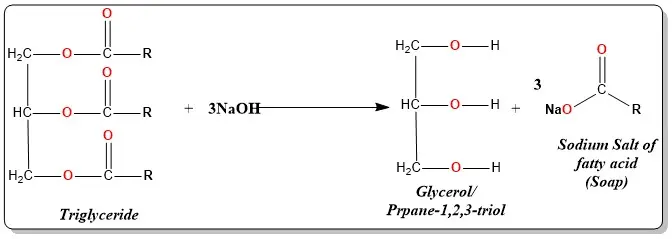
When fats or oils are heated with a strong alkali such as sodium hydroxide (NaOH) or potassium hydroxide (KOH), the ester bonds are hydrolysed. The products formed are – Glycerol and Sodium or potassium salts of fatty acids (soap). This alkaline hydrolysis is called saponification.
Industrial Applications
- Manufacture of bathing and laundry soaps.
- Production of glycerol.
- Manufacture of detergents.
Pharmaceutical Importance
The saponification reaction forms the basis for determining the Saponification Value, an important quality-control parameter used to identify fats and oils and estimate the average molecular weight of their fatty acids.
3. Hydrogenation/Hardening of fats
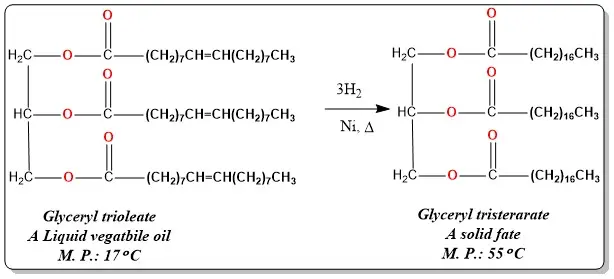
Many vegetable oils are liquids because they contain unsaturated fatty acids with carbon-carbon double bonds. During hydrogenation, hydrogen gas is added across these double bonds in the presence of a nickel catalyst under controlled temperature and pressure. As the double bonds disappear, the oil becomes more saturated, its melting point increases, and it changes from a liquid into a semi-solid or solid fat. This process is called hardening of oils. Liquid vegetable oil can be converted into vegetable ghee (vanaspati) through hydrogenation.
Hardening of oils process is carried out using:
- Hydrogen gas (H₂)
- Nickel catalyst (Ni)
- Controlled temperature and pressure
Pharmaceutical Importance of hydrogenation
Hydrogenation improves – oxidative stability, consistency, shelf life and melting characteristics. Therefore, hydrogenated fats are used in:
- ointment bases
- suppositories
- creams
- lotions
- Lipsticks.
Formation of Trans Fats
If hydrogenation is partial, some naturally occurring cis double bonds change into trans double bonds, forming trans fatty acids. These fats have greater stability but are associated with adverse health effects when consumed in excess. For e.g. partially hydrogenated vegetable oils were widely used to manufacture vegetable ghee (Dalda).
Modern Pharmaceutical Practice
Because of health concerns, modern pharmaceutical and cosmetic formulations prefer trans-free hydrogenated fats or use alternative techniques such as interesterification.
Interesterification
Interesterification is a chemical or enzymatic process in which the fatty acids attached to glycerol molecules are rearranged without changing the overall fatty acid composition of the fat or oil. In simple words, interesterification changes the arrangement of fatty acids in triglycerides to obtain desired physical properties, such as melting point and texture, without producing trans fats.
A common example is the interesterification of soybean oil with fully hydrogenated soybean oil. During the process, fatty acids are redistributed among triglycerides to produce a semi-solid, trans-fat-free fat that is widely used in the manufacture of Cake icing, Biscuits etc. Another example of interesterification is converting cocoa butter to cocoa butter equivalent. Manufacturers interesterify – Palm mid-fraction, Shea butter, Sal fat to produce triglycerides similar to cocoa butter. This produced triglycerides is used in chocolate, Pharmaceutical suppository bases.
4. Hydrogenolysis
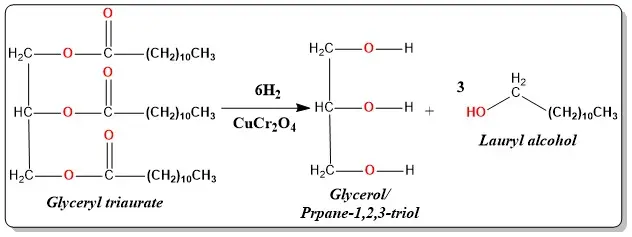
Hydrogenolysis is a reduction reaction in which triglycerides are treated with hydrogen gas in the presence of a copper chromite (CuCr₂O₄) catalyst under high pressure and temperature. Unlike ordinary hydrogenation, this reaction breaks the ester bond. The products formed are – glycerol and long-chain fatty alcohols.
Industrial and Pharmaceutical Importance
- The long-chain fatty alcohols produced are important raw materials for manufacturing of – detergents, surfactants, emulsifiers, cosmetic creams, and shampoos.
- Fatty alcohols such as cetyl alcohol and stearyl alcohol are widely used as – emulsifying agents, thickening agents, stabilizers, and ointment bases.